





ANALYSIS
First use: Oppenheimer, Hiroshima and Houtermans
In a race using scarce U-235, deploying the bomb for real instead of merely demonstrating it was a no-brainer
By STEPHEN BRYEN
JULY 26, 2023
Click to share on WhatsApp (Opens in new window)Click to share on Facebook (Opens in new window)Click to share on Twitter (Opens in new window)Click to share on LinkedIn (Opens in new window)Click to share on Reddit (Opens in new window)Click to share on Pocket (Opens in new window)Click to share on Tumblr (Opens in new window)Click to email a link to a friend (Opens in new window)Click to print (Opens in new window)
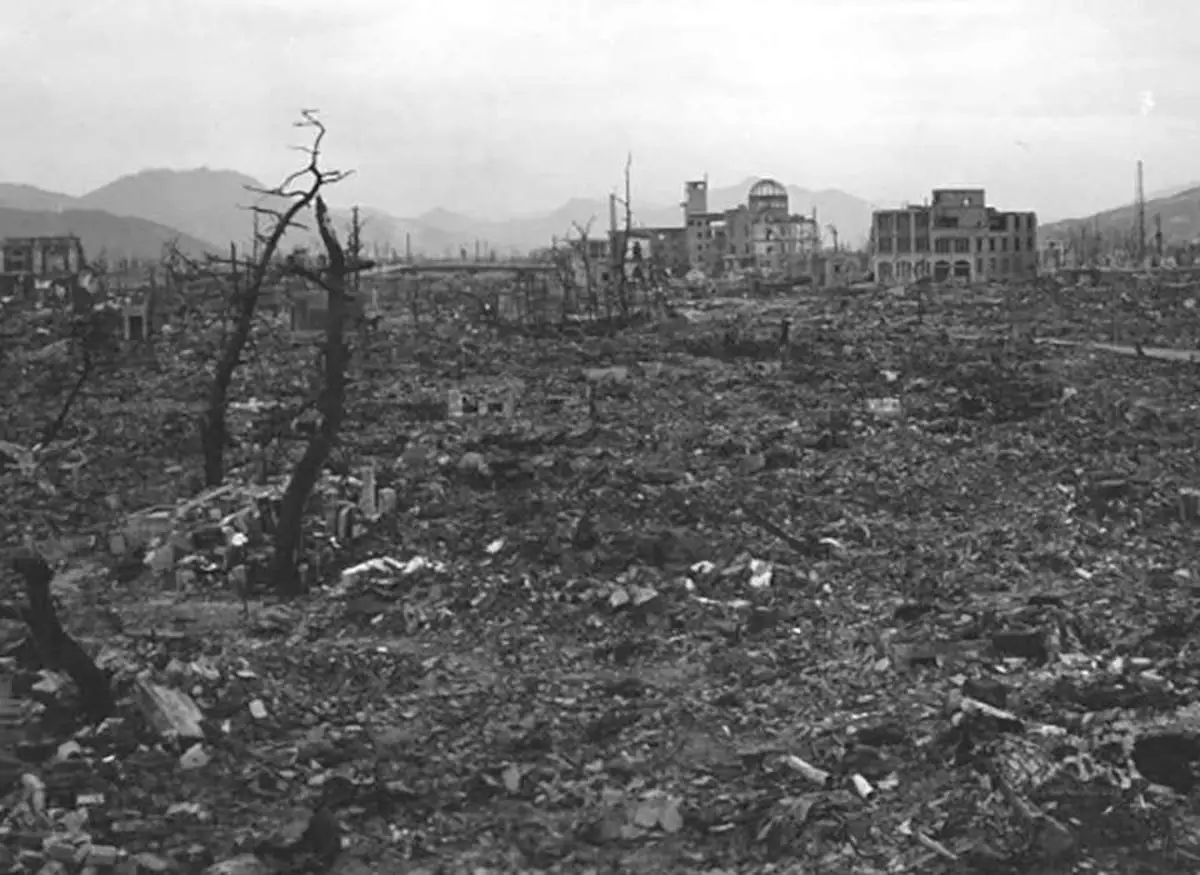
Aftermath of the Hiroshima atomic bombing.
As the film “Oppenheimer” arrives in American theaters, it is important to take a fresh look at the race to produce the atomic bomb and the choice of Hiroshima as its first target. There’s a lot more to learn that isn’t in the movie.

Hiroshima was struck by an 11-kiloton atomic bomb that had never been previously tested. But the task to destroy Hiroshima was critical in stopping Japan’s atomic bomb program and either forcing Japan’s surrender or, if Japan did not surrender, protecting the huge planned US and allied amphibious attack on Japan.
I want to emphasize what you are reading is my own analysis of why Hiroshima was a critical, top priority target enabling the allied invasion of the Japanese mainland. It differs greatly from US explanations, which (when taken on balance) are nonsensical.
If Hiroshima was a civilian target selected by the US government, then it was a war crime to carry out the attack. If it was a strategic, military target, then the attack on the city was justifiable.
It is important to note that the US government was, during and after the war and until today, covering up the real truth about the atomic bomb threats of Germany and Japan. Indeed, General Douglas MacArthur, who ran the US occupation of Japan after the surrender, systematically covered up Japan’s atomic bomb program and Japan’s biological and chemical weapons program in China.
Even today questions are still asked why Hiroshima was chosen? Why did the United States not demonstrate the atomic bomb before actually using it on a Japanese city, followed by dropping a Plutonium-fueled bomb that was used against the Japanese city of Nagasaki.
After the Hiroshima blast, Japan’s top atomic scientists flew to Hiroshima, headed by Yoshio Nishina from the RIKEN institute. Japan was desperately short of aircraft but Nishina and his team of scientists were given top priority.
Japan had two atomic bomb programs, one under the aegis of the army centered at RIKEN called Ni-Go and the other, under the navy, known as the F-Go program, headed by Professor Bunsaku Arakatsu. Late in the war the navy program was far along. The bombs were to be assembled in Korea. Korea had become Japan’s main arsenal supplying the war effort.
Arakatsu and his accelerator at Kyoto Imperial University. Photo: Creative Commons
Japan’s top scientists quickly figured out that the bomb that struck Hiroshima was an atomic weapon. They measured residual radiation with Geiger counters. By assessing the blast patterns on the sides of partly standing buildings, they understood that the bomb was detonated above ground giving it maximum coverage over the target.
Hiroshima was destroyed by a uranium bomb called Little Boy. Testing it was not possible because there was not enough enriched uranium (U-235). Yet there was much greater confidence that the uranium bomb would work and was less complex than the plutonium implosion device, known as Fat Man, dropped a few days later on Nagasaki.
The Little Boy bomb readied for delivery to the Army Air Force. Photo: Creative Commons
One of the big secrets of World War II is that both Germany and Japan were far along on atomic weapons development. For political reasons, the US did not want the American population to know just how dangerous atomic bomb development was to the soldiers fighting in Europe and in Asia.
Had the Germans been able to set off an atomic blast during the Battle of the Bulge, US and British forces would have been wiped out. Had Japan unleashed an atomic bomb on the US fleet, the US invasion force would have been destroyed.
Japan even had plans to launch an aircraft from a submarine carrying an atomic bomb. Japan was planning to destroy San Francisco and force the United States into peace negotiations favorable to Japan. Japan’s backup plan was to hit San Francisco with biological weapons launched by the same aircraft.
A very controversial book published in Germany in 2005 (Hitler’s Bomb, by Rainer Karlsch) claims that the Nazi regime set off a crude nuclear device at the military testing ground at Ohrdruf in southern Germany, then housing thousands of concentration camp inmates who became the bomb’s victims.
The US also was aware that Germany was working on long range bombers that could attack New York or Washington, DC. Called the Amerikabomber by the Germans, four different prototypes were built by different German aerospace companies (Messerschmidt, Junkers, Focke-Wulf, Heinkel, Horten Brothers), but none went into serial production. During the war, American cities either turned off the lights or used blackout curtains, fearing a Nazi air attack.
Boris Pash. Photo: Legion Media
Since the war, there has been a lot of mythology that the Germans were not that far along on a bomb and that Japan was even farther behind. The US-British Alsos Mission, headed by Boris Pash, which sent US and British scientists to Europe and Japan, reported that while both countries were working on atomic bombs, they were not even close to having them.