







Will the ECB cut interest rates next year and why does it matter?
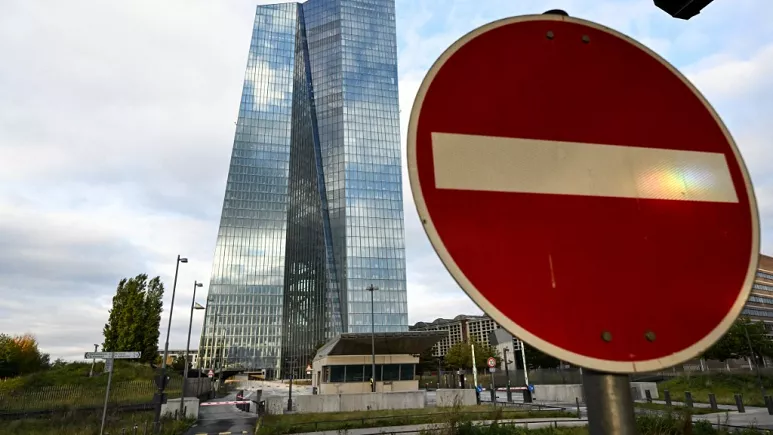
A stop sign is pictured in front of the headquarters of the European Central Bank (ECB) in Frankfurt
By Osama Rizvi
Published on 06/12/2023 – 09:20•Updated 11:21
Share this article
Comments
At the end of October, the European Central Bank (ECB) held its interest rate steady at 4% after 10 consecutive hikes that started in July 2022. As inflation cools, economist Osama Rizvi explains for Euronews Business the prospects of an interest rate cut and why it matters to Europeans.
The ECB will next meet on 14 December 2023 and many analysts are predicting different outcomes from the central bank of Europe – to hold, increase, or cut interest rates. Last time, the bank paused the rate at 4%.
“In recent weeks, remarks from ECB officials have illustrated that the time of peaceful consensus within the Governing Council is over. Some members have said they remain open to the prospect of a further rate hike, others have said it is too early to discuss rate cuts, and still others have acknowledged that rate cuts will indeed be considered in the course of 2024. Experienced ECB watchers know that such a varied list of comments can only mean that the discussion of what to do next is in full swing,” analysts at ING said.

How do interest rates impact you?
Higher interest rates adversely impact consumers as mortgages and interest on other loans become expensive. Moreover, as the cost of businesses increases (now that the interest rates are high) it is usually passed on to the consumers which essentially means that you end up paying more for your everyday items.
This feeds into the cost of living crisis, which is impacting most people across Europe one way or another. Meanwhile, when rates fall the opposite of the above follows and the economy expands overall.
The central bank of the Eurozone is the European Central Bank which meets 8 times annually (every 6 weeks) to determine the rate. It is called the Governing Council monetary policy meeting.
Novo Nordisk ascent: Will Europe’s biggest company continue to soar?
Why are interest rates being increased?
There are various functions of a rising interest rate but the most significant is to fight inflation.
The world witnessed an unprecedented increase in inflation post-pandemic. There were many reasons behind this but an increase in money supply was the main one. Also, as supply chains across the world were distressed, disturbed and disconnected, these disruptions caused prices of goods to increase as could be observed in the Baltic Dry Index – which tracks the shipping cost for bulk dry goods – that touched its highest in 12 years.
This resulted in an increase in raw material costs. A business in Europe importing yarn from Bangladesh now had to pay twice its pre-pandemic levels. The owner would pass this increase in cost to the consumers which subsequently causes inflation.
Central banks across the world, including the European Central Bank (ECB), have been fighting inflation by hiking interest rates.
Inflation in Europe falls to 2.4%, as higher interest rates squeeze growth
Will the ECB cut rates in 2024?
Now that we know the ins and outs of monetary policy and its relation to inflation, it is time to ask the main question: will the ECB cut its rate next time?
Eurozone inflation fell to 2.4% in November, the lowest since July 2021. The ECB has a target of 2 % inflation and things seem to be moving in this direction.
The current mood seems that the ECB will become the first central bank to cut rates as indicated by the comments from Francois Villeroy de Galhau at a recent conference. He said that sans a shock we can expect that the rate hiking cycle is now over as progress in disinflation has been “faster than expected”.
This led to government bond yields dropping to multi-month lows as investors are now betting on a cut with 75% chances of a rate cut compared to a 40% last week. Goldman Sachs has also moved its estimated date of a rate cut by the ECB from the third quarter of 2024 to the second.
However, others are saying it is too early to pop open the champagne bottle as the fight against inflation is not over. Innes McFee, chief economist at Oxford Economics, said that the ECB is the most vulnerable to making a monetary policy mistake (by cutting rates too early).
Chrsitine Lagarde, the president of the ECB, expects inflation to rise again
Chrsitine Lagarde, the president of the ECB, expects inflation to rise againARIS OIKONOMOU/AFP or licensors
Chrsitine Lagarde, the president of the ECB, shared her concerns that she expects inflation to rise again as subsidies on energy prices will be removed.
At the start of last month she also said that it won’t be before the “next couple of quarters” that the ECB will start to cut rates.
“Although soft indicators have stabilised at low levels recently, the weak macro economic backdrop no longer justifies rate hikes, even for the hawks. But when meeting next week, the ECB will not only be looking at the weakening of growth and sharper-than-expected drop in eurozone inflation.,” ING also noted in its latest report ahead of the ECB meeting.
Moreover, as ING also highlighted, the ECB will have to consider the still relatively solid labour market and wage growth.
“And with core and headline inflation still above target, any discussion on imminent rate cuts would be premature,” ING added.