





LIVE
POLITICSPAKISTAN
Pakistan elections: Sharif favored to win in fraught vote
LIVE
POLITICSPAKISTAN
Pakistan elections: Sharif favored to win in fraught vote
Published 8 hours agoPublished 8 hours agolast updated 5 minutes agolast updated 5 minutes ago
Over 100 million people are eligible to vote, but the country is still reeling from a deadly bomb blast in Baluchistan on the eve of the election. DW has the latest.
https://p.dw.com/p/4c8qB
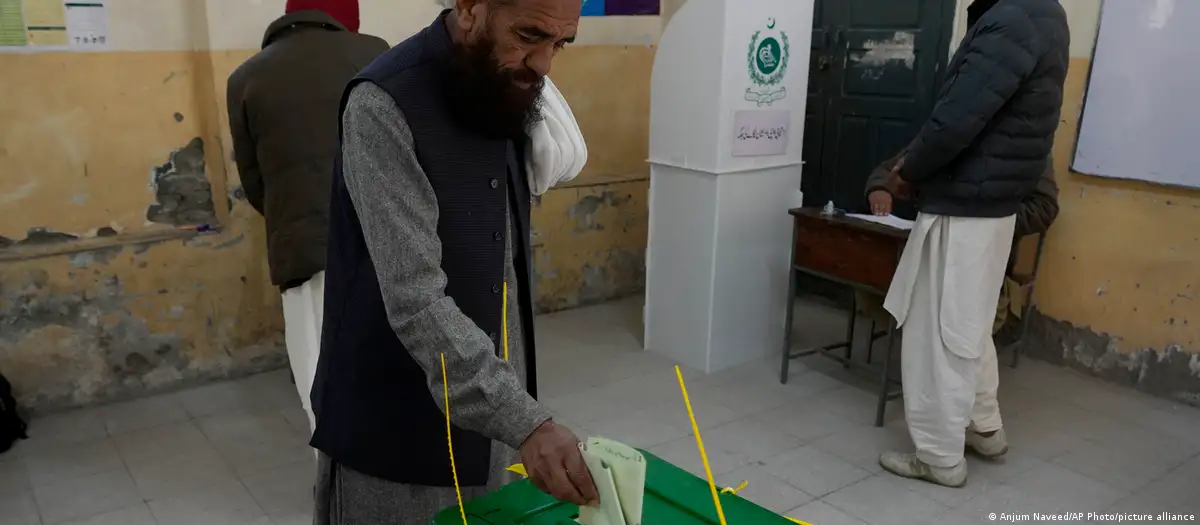
A Pakistani casts his vote at a polling station during the country’s parliamentary elections, in Islamabad, Pakistan
Voting began at 8 a.m. local time with former PM Khan in jail and Sharif tipped to winImage: Anjum Naveed/AP Photo/picture alliance
Skip next section What you need to know
What you need to know
More than 128 million voters are registered
Key issues include the economic crisis, security issues and the power of the military
The projected front-runner is former Premier Nawaz Sharif of the Pakistan Muslim League
Former Prime Minister Imran Khan is barred from running
At least 26 people were killed in a bomb blast in Baluchistan on the eve of the election
Skip next section Several police killed in bomb, gun attack as violence mounts
5 minutes ago5 minutes ago
Several police killed in bomb, gun attack as violence mounts
Attackers have set off a bomb and opened fire on officers, killing five in Pakistan’s northwest, police said on Thursday.
The incident is the latest in the unrest that has beset the country as it goes to the poll in general elections, with tens of thousands of soldiers deployed across the country in a bid to maintain security.

Earlier in the day, troops in the town of Kot Azam in northwestern Khyber Pakhtunkhwa came under fire from unidentified gunmen, with one soldier killed, according to local police official Fiyyaz Khan.
Unidentified assailants also attacked two polling stations in southwestern Baluchistan province with two hand grenades, hurting no one but spreading panic among voters, police said.
An unconfirmed report has also spoken of a blast near a polling station in southwest Pakistan that killed two people.
On the eve of the election, twin bombings in Baluchistan hit election offices, killing at least 26 people.
https://p.dw.com/p/4c9xL
Copy link
Skip next section Low voter turnout could damage chances of Khan’s PTI — DW correspondent
2 hours ago2 hours ago
Low voter turnout could damage chances of Khan’s PTI — DW correspondent
The turnout in the Pakistan elections has been fairly low in many cities up to noon, according to DW reporter Shamil Shams, who is following events from Karachi.
He said that if the trend continues, it could hurt the chances of ex-Prime Minister Imran Khan’s Pakistan Tehreek-e-Insaf (PTI) party, which is relying on large voter numbers to trump its main rival, the Pakistan Muslim League of former three-time Premier Nawaz Sharif.
Candidates from the PTI are essentially barred from running under the party banner and appear on the ballot as independents.
https://p.dw.com/p/4c9cl
Copy link
Skip next section Imran Khan supporters slam closure of phone and internet
3 hours ago3 hours ago
Imran Khan supporters slam closure of phone and internet
Supporters of jailed ex-Premier Imran Khan have told DW that the closure by authorities of internet and phone access is a ploy to dissuade them from voting for him — a claim Pakistan’s caretaker government denies.
The lack of internet and phone access has at any rate created numerous problems for citizens wanting to cast their ballots, according to DW reporter Shamil Shams, who is located in Karachi.
Shams said that the Election Commission’s polling hotline, which voters need for procedural matters, cannot be accessed, leading to a slowing of the voting process.
He said there were also reports of sporadic electricity blackouts in some parts of the country as well.
https://p.dw.com/p/4c9cM
Copy link
Skip next section Voters brave cold weather, threat of violence
3 hours ago3 hours ago
Voters brave cold weather, threat of violence
Pakistani voters have so far shown themselves undeterred by very cold weather in several parts of the country, while the threat of violence is highlighted by the tens of thousands of troops deployed across the country.
There has been heavy snowfall in the ski resort of Murree, near the capital, Islamabad, and snow also fell in eastern Punjab province and the mountains of southern Sindh province.
Panic broke out among voters at two polling stations in southwestern Baluchistan province after unidentified assailants threw hand grenades, police said.
The incident comes after twin bombings in the region hit election offices on Wednesday, killing at least 26 people.
In northwestern Khyber Pakhtunkhwa province, which borders Afghanistan, troops in the town of Kot Azam came under fire from unidentified gunmen, with one soldier killed, according to local police official Fiyyaz Khan.
https://p.dw.com/p/4c9bV
Copy link
Skip next section Pakistan suspends mobile telephone services for election day
6 hours ago6 hours ago
Pakistan suspends mobile telephone services for election day
Mobile phone services across Pakistan have been suspended for a day as the country goes to the polls, the interior ministry said, citing the need to “maintain law and order.”
In a statement, a ministry spokesman said: “It has been decided to temporarily suspend the mobile service across the country.”
The build-up to Thursday’s election has seen an upturn in violence in Pakistan, including a bomb attack which left at least 26 people dead in Baluchistan on Wednesday.
https://p.dw.com/p/4c9Vh
Copy link
Skip next section ‘Law and order is collapsing’ but Pakistan ‘determined to have elections’
7 hours ago7 hours ago
‘Law and order is collapsing’ but Pakistan ‘determined to have elections’
Pakistan’s former ambassador to the United Kingdom and the Ireland has said the bombings on the eve of the country’s parliamentary elections suggest a “collapse in law and order” and undermine efforts to establish a democratic process.
“These violent groups which are committing so much violence throughout Pakistan are very deliberately targeting the electoral process in order to disrupt what is happening,” Akbar Ahmed told DW.
“This causes a lot of dismay, anger and confusion, and just adds to the sense of the elections being a very, very difficult exercise — the violence, the lack of faith in the process, the general sense in the public that the elections may be rigged, may not be fair and free.”
Nevertheless, he said he saw Pakistan as “a nation determined to have elections,” something which he believes should be important to the West.
“[Pakistan is] a nation of 230-240 million people,” he said. “It’s the only nuclear country in the Muslim world. It had the first female Prime Minister. Geopolitically, it has India on one side, China on the other, and Iran and Afghanistan on its western borders.
“So, in spite of all the crises, in spite of the problems, I think the West should be encouraged that Pakistan is ensuring that elections take place as freely and fairly as possible.”
https://p.dw.com/p/4c9VO
Copy link
Skip next section What are the issues?
7 hours ago7 hours ago
What are the issues?
Pakistan’s new government will have their work cut out for them, and foremost on any agenda will be addressing an ongoing economic crisis.
Pakistan currently faces high unemployment combined with skyrocketing prices of basic goods and energy.
This is compounded by political turmoil, with many voters saying they believe the contest has been decided in advance by Pakistan’s powerful military.
Voter apathy has been reflected in a lackluster campaign season in the run up to voting day.
Pakistan: Elections amid energy and economic crisis
12:57
Security issues are another problem, with militant attacks occurring at a greater frequency in recent months.
In the latest incident on Wednesday, two bombings in Baluchistan province killed at least 26 people. An offshoot of the so-called “Islamic State” claimed responsibility for one of the blasts.
Authorities have said they are boosting security at polling booths following the attacks.
Pakistan elections: What is at stake?
07:03
https://p.dw.com/p/4c8sB
Copy link
Skip next section Who are the main contenders?
7 hours ago7 hours ago
Who are the main contenders?
Forty-four political parties will compete, but the projected front-runner is the Pakistan Muslim League, led by three-time former Premier Nawaz Sharif, who returned to Pakistan from exile last year.
Sharif is currently considered as the top contender to become prime minister, and analysts say his return comes with the backing of Pakistan’s powerful military establishment.
The Pakistan Peoples Party (PPP), led by Bilawal Bhutto Zardari, son of assassinated former prime minister Benazir Bhutto, could play the role of kingmaker if no single party wins enough seats to form a government outright.
Bilawal Bhutto: ‘Pakistan needs an end to divisive politics’
05:35
Independent candidates have the option to join any party after the elections.
However, former cricket star Imran Khan is barred from running and is currently serving a jail term on charges linked to corruption and revealing state secrets.
Khan was ousted in an April 2022 no-confidence vote, ostensibly after falling out with Pakistan’s military establishment.
Candidates from Khan’s Pakistan Tehreek-e-Insaf (PTI) are essentially barred from running under the party banner and appear on the ballot as independents.
Critics say Pakistan’s military has conspired to keep Khan and the PTI away from the levers of power, and therefore have questioned the election’s legitimacy.
Military maintains tight hold on Pakistan ahead of elections
02:39
https://p.dw.com/p/4c8qc
Copy link
Skip next section How does the election work?
7 hours ago7 hours ago
How does the election work?
Polls opened on Thursday in Pakistan’s 12th general elections, with more than 128 million registered voters eligible to choose the South Asian country’s next government.
Voting will take place for 336 seats in the federal legislature, called the National Assembly, and for 749 seats in state legislatures called the Provincial Assembly, comprising Baluchistan, Khyber Pakhtunkhwa, Punjab and Sindh provinces.
In the federal legislature, 266 seats are decided on polling day, and 70 seats (60 for women/10 for non-Muslims) are allotted according to each party’s strength.
Members of the polling staff assembly voting booth at a polling station for the parliamentary elections, in KarachiMembers of the polling staff assembly voting booth at a polling station for the parliamentary elections, in Karachi
A result is expected by FridayImage: Fareed Khan/AP Photo/picture alliance
The election primarily uses a first-past-the-post electoral system.
After the election, the new parliament will choose the country’s next prime minister. If no party wins an outright majority, then the one with the biggest share of assembly seats can form a coalition government.
The new prime minister picks Cabinet ministers, who form the federal government.
Pakistan minister: February 8 elections ‘will be fair’
05:00
https://p.dw.com/p/4c8qj
Copy link
Skip next section When can we expect results?
8 hours ago8 hours ago
When can we expect results?
Polls are scheduled to open at 8 a.m. (03:00 UTC) and voting will continue until 5 p.m. local time.
Ballots will be counted soon after polls close, and tentative, unofficial results are expected to emerge within a few hours.
The Election Commission of Pakistan is required by law to publish official results within 14 days of the election.
However, official results could be announced as early as Friday.
The latest official results could be announced is Thursday, February 22.