



POLITICSSERBIA
EU’s Kosovo-Serbia peace plan faces backlash in Belgrade
11 hours ago11 hours ago
Thousands of nationalists in Belgrade protested against a Western-backed deal for the normalization of ties between Serbia and Kosovo, which they see as recognition of Kosovo’s sovereignty and therefore “unacceptable.”
https://p.dw.com/p/4Os0d
Several thousand people gathered in Belgrade on Friday evening to rally against Kosovo-Serbia talks on an 11-point agreement proposed by the European Union.
The plan aims to improve the severed ties between Serbia and Kosovo, formerly a part of Kosovo that declared independence in 2008.

Why are Serbian nationalists protesting?
The demonstrations come ahead of a meeting to be held between Serbian President Aleksandar Vucic and Kosovar Prime Minister Albin Kurti on Saturday in North Macedonia.
‘Serbia will never accept the independence of Kosovo’
08:42
EU foreign policy chief Josep Borrell is to chair the meeting that aims for the two Balkan countries to mend existing ties to achieve their goals of joining the EU.
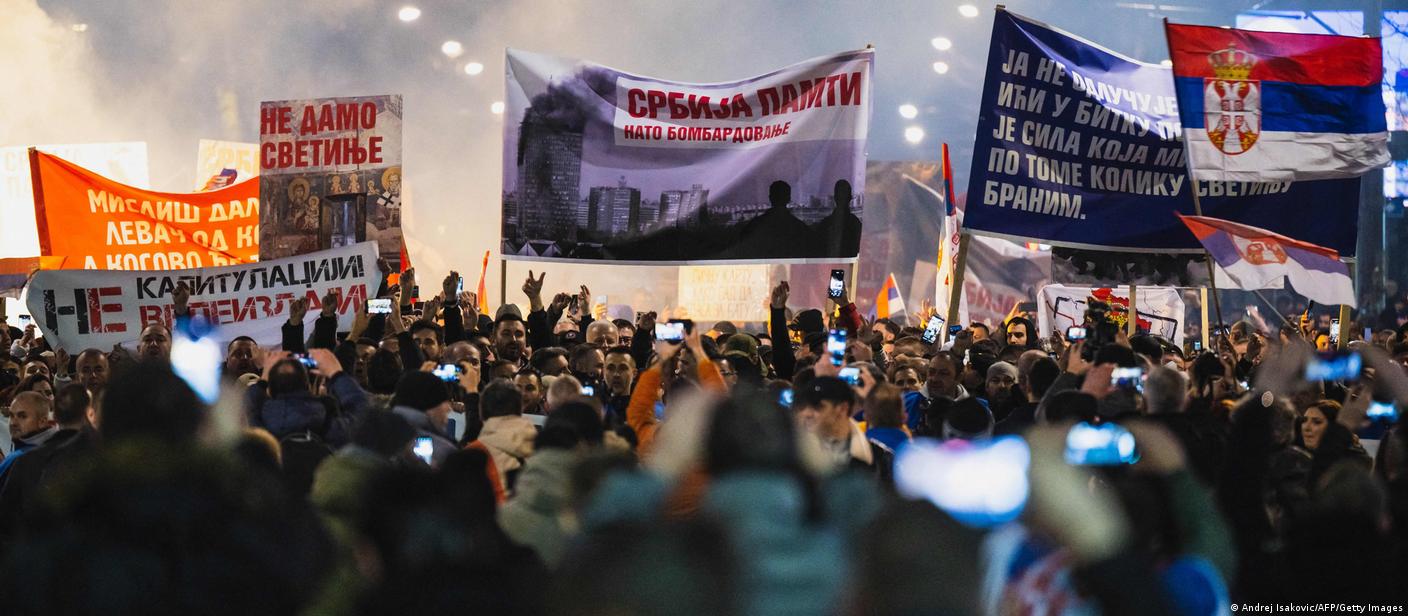
The protesters gathered to criticize Vucic’s policy and urged him “to reject everything” in the upcoming meeting.
Banners reading “No to capitulation,” and “Kosovo is not for sale” were also carried by the demonstrators.
“It [the deal] is definitely a recognition [of Kosovo], whether you say it explicitly or whether it is implied indirectly, it is still recognition and it is not acceptable,” said Milos Jovanovic, one of the protest organizers and head of the Democratic Party of Serbia.
Protestors holding a banner reading Protestors holding a banner reading
Serbian protesters carried banners with slogans stating: “No to capitulation,” denouncing the EU plan, as they marched towards the presidency in BelgradeImage: Darko Vojinovic/AP Photo/picture alliance
A long-standing issue
Tensions have existed among groups in the region for decades after the war in 1998-99 between Serbian forces and ethnic Albanian insurgents. The war ended when NATO bombed Serbia in 1999 over the expulsion of Albanians in Kosovo.
Since 2008 when Kosovo declared independence from Serbia, Belgrade, with the backing of China and Russia, has not recognized Kosovo’s sovereignty.
However, many, though not all, Western countries have recognized Kosovo as an independent state, with its ethnic Albanian majority population of 1.8 million.
With Russia currently waging a war in Ukraine, improving bilateral relations between Serbia and Kosovo has become essential for maintaining peace in the Balkan region.
Albin Kurti: ‘Serbia is not a normal democratic country’
06:17
Last month, Belgrade and Pristina failed to come to terms in Brussels when the EU bloc revealed the peace plan.
According to the agreement, Serbia does not have to identify Kosovo as an independent nation but will have to recognize official documents such as passports, license plates, and diplomas.
Borrell has urged Kurti and Vucic to normalize ties between the two countries. He wrote in a blog piece that he sees the move as “an important step” towards their goal of joining the EU in the future.
aa/sms (AFP, Reuters, AP)