







NASA’s James Webb Space Telescope captures image of a dying star
The telescope’s infrared lens observed the gas and dust flung into space by a huge star 15,000 light-years away. The shimmering purple cast-off material once comprised the star’s outer layer.
Samuel Osborne
News reporter @samuelosborne93
Wednesday 15 March 2023 04:55, UK

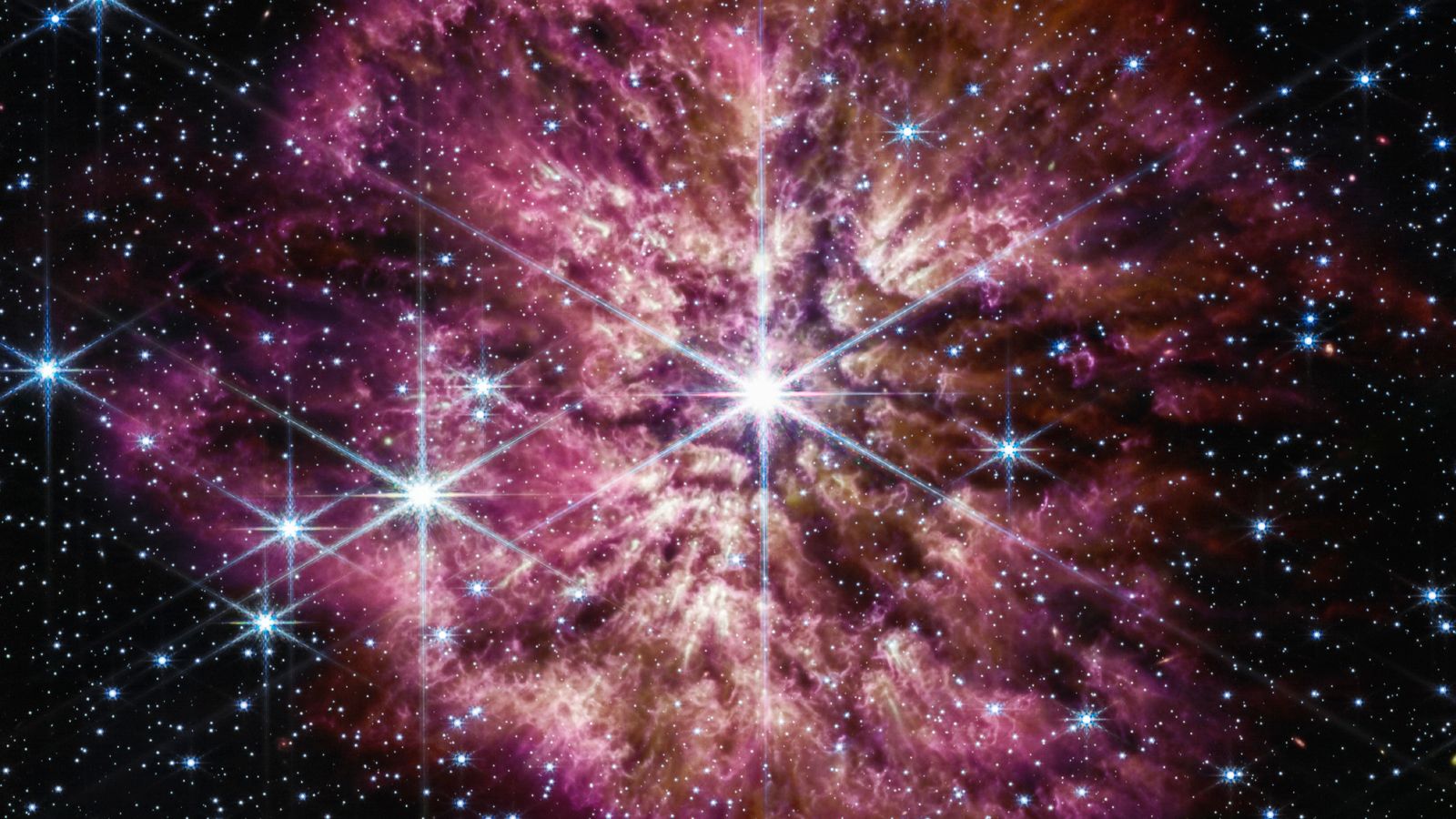
This image provided by NASA shows the star Wolf-Rayet 124, centre, captured by the James Webb Space Telescope in June 2022. A surrounding nebula is made of material cast off from the aging star in random ejections, and from dust produced in the ensuing turbulence. The telescope captured the rare and fleeting phase of the star on the cusp of death. (NASA, ESA, CSA, STScI, Webb ERO Production Team via AP)
Image:
The star Wolf-Rayet 124 and a surrounding nebula made of material cast off in random ejections. Pic: NASA
Why you can trust Sky News
NASA’s James Webb Space Telescope has captured a stunning image of a star on the cusp of death.
The telescope’s infrared lens observed the gas and dust flung into space by a huge star 15,000 light-years away.
The shimmering purple cast-off material once comprised the outer layer of the star Wolf-Rayet 124.
It sits in the constellation Sagittarius and is 30 times more massive than our sun and has already shed enough material to account for 10 suns, according to NASA.
“What we’re seeing in this beautiful new image at the very centre is a star,” said NASA’s Amber Straughn.
“The light from that star has been travelling through space for about 15,000 years, it’s 15,000 light years away, until it hit the detectors on the telescope.
“And the material that you’re seeing around the central star that looks like dust is dust.
MORE ON NASA
NASA is tracking asteroid 2023 DW. Pic: NASA Asteroid Watch/Twitter
NASA tracking new asteroid that has ‘very small chance of impacting Earth in 2046’
Billions of years ago, waves on the surface of a shallow lake stirred up sediment at the lake bottom. Over time, the sediment formed into rocks with rippled textures that are the clearest evidence of waves and water that NASA’s Curiosity Mars rover has ever found.
Credits: NASA/JPL-Caltech/MSSS
NASA finds evidence of lakes in unexpected region of Mars
COMPOSITE FOR TOM'S FEATURE
NASA Columbia disaster: The investigation into one of history’s worst space tragedies – and its lasting legacy
Related Topics:
NASA
“And so at the end of a star’s life, they shed their outer material, their outer layers out into the rest of the universe.”
She added: “I think this is one of the most beautiful concepts in all of astronomy. This is Carl Sagan’s Stardust concept.
“The fact that the iron in your blood and the calcium in your bones was literally forged inside of a star that exploded billions of years ago.
“And that’s what we’re seeing in this new image. That dust is spreading out into the cosmos and will eventually create planets. And this is how we got here, in fact.”
Telescope captures delicate details
NASA released the picture at the South by Southwest conference in Austin, Texas.
The observation was among the first made by Webb following its launch in late 2021.
The Hubble Space Telescope snapped a shot of the same transitioning star a few decades ago – but it appeared more like a fireball, without the delicate details.
Such a transformation occurs only in some stars and is normally the last step before they explode, going supernova, according to scientists.
Last year the telescope captured an image of dust rings resembling a fingerprint created by two stars and took its first image of a planet outside of the solar system.
Related Topics
NASA