





Secretary of Defense Lloyd J. Austin III briefs the press from the Pentagon Briefing Room, Washington, D.C., Feb. 19, 2021. (DoD Photo by U.S. Air Force Staff Sgt. Jack Sanders)
QIOSK
US launches airstrikes in Syria after American killed in drone attack
This comes within days of lawmaker attempts to pass measures repealing blanket military authorities and to bring Americans home.
MARCH 24, 2023
Written by
Kelley Beaucar Vlahos
Share
Print
The Defense Department said late Thursday that it had launched a series of airstrikes in eastern Syria after a drone attack killed one U.S. contractor and injured five soldiers operating on a coalition base in northeastern Syria. An additional U.S. contractor was also hurt in the attack.
According to a statement by Secretary of Defense Lloyd Austin, the Americans conducted precision airstrikes in eastern Syria against facilities used by Iran’s Revolutionary Guard (IRGC).

“At the direction of President Biden, I authorized U.S. Central Command forces to conduct precision airstrikes tonight in eastern Syria against facilities used by groups affiliated with Iran’s Islamic Revolutionary Guards Corps (IRGC),” he said. “The airstrikes were conducted in response to today’s attack as well as a series of recent attacks against Coalition forces in Syria by groups affiliated with the IRGC.”
These precision strikes, said the DoD, “are intended to protect and defend U.S. personnel. The United States took proportionate and deliberate action intended to limit the risk of escalation and minimize casualties.”
The statement said the intelligence community had determined that the drone had been of “Iranian origin,” but did not say why the IRGC had been pinpointed as responsible for the attacks.
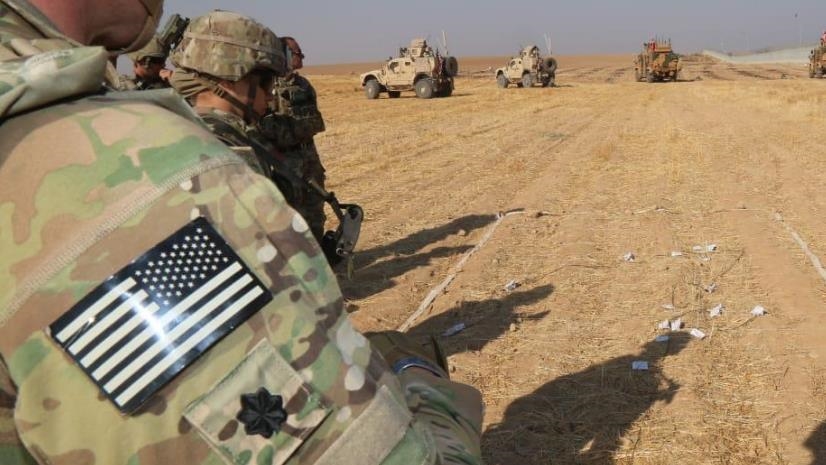
As of December, there were 900 U.S. troops in the country where they continue to conduct operations against ISIS but have been targeted for years now by what U.S. officials say are Iranian-backed militias.
According to CBS News, the American strikes reportedly killed six Iranian-backed fighters at an arms depot in the Harabesh neighborhood in the eastern city of Deir el-Zour, another two fighters in Mayadeen, and a strike hit a military post near the town of Boukamal along the border with Iraq. CBS was relying on the Syrian Observatory for Human Rights and these reports could not be independently verified.
According to Reuters, the Iranians are denying any deaths connected to the U.S. airstrikes:
Iran’s state Press TV, saying no Iranian had been killed in the attack, quoted local sources as denying the target was an Iran-aligned military post, but that a rural development center and a grain center near a military airport were hit.
It said: “A military source in Syria told Press TV that the resistance groups reserve their right to respond to the American attack and will take reciprocal action.”
In early March Gen. Mark Milley, the Chairman of the Joint Chiefs of Staff, made a surprise visit to the troops in Syria, where the U.S. has had a military presence for eight years. He tied the mission there to the security of the U.S. and said the risk of keeping troops there was “worth” the “enduring defeat of ISIS and continuing to support our friends and allies in the region.”
Not everyone thinks that mission is as clear and the risk as important. Recently Rep. Matt Gaetz (R-Fla.) offered a bill for vote in the House that would bring U.S. troops home from the region. Even with help from the Congressional Progressive Caucus and other Republicans, it failed 321-103 on March 8.
Sen. Rand Paul (R-Ky.) has also tried in recent says to push a measure that would repeal the 2001 AUMF which he says is used to justify operations there, as well as a number of other overseas interventions since the law was passed in the wake of 9/11, 20 years ago. He says it should be up to Congress whether to continue these operations, not the sole authority of the White House. His amendment failed 86-9 in the Senate on Thursday.
Written by
Kelley Beaucar Vlahos