







Live
Budget news – live: Pension and childcare changes go further than expected – but have we seen ‘giveaway to rich’?
Chancellor Jeremy Hunt delivers his first budget – with funded childcare to be extended to cover children over nine months, the energy price guarantee extended until June, and the pension lifetime allowance abolished.
LIVE
Watch our budget coverage live
Why you can trust Sky News
Key points
Every announcement from Jeremy Hunt’s budget View post
Pension lifetime allowance abolished View post
Jon Craig: This was the rabbit out of the hat – but it certainly looks like a giveaway to the rich View post
30 hours of free childcare for children over nine months View post
Tamara Cohen: The election politics behind the chancellor’s childcare plans View post
Sam Coates: Jeremy Hunt’s challenge is whether voters feel the benefits fast enough View post
Live reporting by Bradley Young
Sort by:
LatestSort by latest OldestSort by oldest
4m ago
13:30
Bullish chancellor delivers fighting talk as he arrives to address Tory MPs

A bullish Jeremy Hunt arrives to address Tory MPs at the traditional 1922 Committee meeting and delivers some fighting talk.
“I shall be telling them how the budget will help us win the general election,” the chancellor tells journalists in the committee corridor.
“There’s no path for us without a reputation for economic competence.”
Mr Hunt also reveals that he had a friendly chat with Deputy Speaker Dame Eleanor Laing after the budget, following his apparent slur during his speech when he referred to her during his speech as “older”.
Mr Hunt is 56 and Dame Eleanor, who recently returned to the Commons after surgery, turned 65 last month.
“We’re old friends,” he told Sky News.
Copy link
21m ago
13:14
Hunt has set out an ‘implausibly tight’ spending plan
Jeremy Hunt has produced an “implausibly tight” long-term public spending plan, according to the CEO of the Resolution Foundation thinktank.
Torsten Bell said that after the next election the government can expect 1% real growth in public spending each year, and if it wants to increase defence spending to 2.5% of GDP and support the health service and schools, “that would mean pretty huge cuts to other departments.”
Asked if Mr Hunt has left himself with little economic room to play with in the run-up to the election, Mr Bell said he has bound himself with a self-imposed fiscal rule.
But he added Mr Hunt “doesn’t need that much headroom” immediately before an election because he can “run right up to the wire in terms of that fiscal rule.”
Mr Bell said: “The big lesson from history is that chancellors should be leaving themselves more headroom against their fiscal rule so they don’t end up doing short term things just to make sure they stick to those rules.
“But that’s not what he did in the autumn and that’s why we’ve ended up with a silly corporate tax package today.”
Copy link
41m ago
12:54
Budget to encourage ‘110,000 people into work’
Budget changes announced today will add 110,000 people to the workforce within five years, according to the chair of the Office for Budget Responsibility.
Richard Hughes said increased childcare support will contribute around 60,000 workers and allow others to extend their working hours.
He explained that scrapping the lifetime allowance cap on untaxed private pension savings will increase the workforce by 15,000 people, while the remainder will be made up of those encouraged by other policies like a voluntary scheme for those with disabilities which will invest up to £4,000 to help them into work.
The chancellor’s policies boosting the labour force will increase output by around 0.2%, according to Mr Hughes.
He said “the economic outlook in general is brighter than we forecast back in November” due to gas prices, interests rates and inflation coming down, resulting in GDP declining 0.5% rather than 2%, as was expected by the OBR.
The chancellor announced he expects inflation to fall to 2.9% by December this year, from 10.7% in the final quarter of 2022.
But the cost of energy will remain more than double what it was before the invasion of Ukraine in the medium term, said Mr Hughes.
Copy link
48m ago
12:46
Revenge of the Trussites begins as MPs start debating budget
As MPs begin four days of debate on Jeremy Hunt’s Budget, the tax grumbles on the Tory back benches have already begun. And the revenge of the Trussites is under way.
Leading the charge is Ranil Jayawardena, who was in Liz Truss’s cabinet as environment secretary for what seemed like all of five minutes last autumn and is now an outrider for Trussonomics.
He’s one of a quartet of former cabinet ministers – along with Priti Patel, Sir John Redwood and Dame Andrea Leadsom – who have wasted no time in turning up the heat on the chancellor.
Mr Jayawardena, a leading spokesman for the former prime minister’s Conservative Growth Group, demands a rethink on the corporation tax hike.
“Any increase in corporation tax will make us less competitive, reduce investment in the long run, stifle job creation, all of which are required for growth,” he complains.
And he goes on: “You don’t have to believe me, even the IFS (Institute for Fiscal Studies) says that this won’t raise the expected revenue. The increase in corporate tax won’t raise expected revenue that is currently suggested by some.”
He also hits out at the VAT threshold for small businesses, claiming: “Today it is £85,000. It’s been like that since 2017, (it) is planned to remain like that until at least 2026. “
That means, he claims, that 60,000 extra businesses are being dragged into this threshold and it halts their growth.
He says there’s an injustice in family taxation, because single earners with two children pay more tax than those with no children.
And he even hits out at Mr Hunt’s new childcare policy: “Instead of Government dictating how many hours of free childcare and who from in the years ahead, what about moving to a system of tax reliefs so that parents can pay for the childcare they want from who they want?
“Or indeed, even a radical thought: one parent could choose to stay at home, allowing the other to work extra hours if that’s what they want to do.”
It’s Ms Patel who begins the backbench tax backlash by challenging Mr Hunt on the corporation tax rise. “Why now?” she asked as she urges him to keep it under review.
Then Dame Andrea, a leading campaigner on childcare, wants an attendance allowance for grandparents looking after their grandchildren.
And on Mr Hunt’s abolition of the pensions allowance limit, she tells MPs it should have been done a long time ago.
Well, she was a Treasury minister and then a long-serving cabinet minister under three prime ministers.
Sir John completes the quartet by saying he wants to take issue with the chancellor over the need to boost investment and “get a lot more company activity in growing what we do here in Britain”.
Away from the Commons chamber, in a large committee room upstairs, within the next few minutes Mr Hunt is appearing before Tory MPs at the traditional budget day meeting of the backbench 1922 Committee.
That’s a gathering traditionally attended by loyalists rather than rebels. But not always!
Copy link
Advertisement
1h ago
12:35
Budget Q&A: When do pension and childcare changes start? How have markets reacted? Are Tories improving in polls?
Business presenter Ian King, deputy political editor Sam Coates, political correspondent Liz Bates and financial expert Kalpana Fitzpatrick are answering your budget questions.
You can follow along live here:
Budget Q&A: When do pension and childcare changes start? How have markets reacted? Are Tories improving in polls?
Sky News
Copy link
1h ago
12:30
‘Amazing’ public support for walkout but government condemned as hundreds of thousands join day of industrial action
Hundreds of thousands of workers are on strike today in what is believed to be the biggest walkout since the current wave of industrial action began.
Teachers, university lecturers, civil servants, junior doctors, London Underground drivers and BBC journalists are among those taking to picket lines around the country to coincide with budget day.
Members of several trade unions are involved in the action amid widespread anger over issues including pay, jobs, pensions and conditions.
You can read more here:
Strikes: ‘Amazing’ public support for walkout but government condemned as hundreds of thousands join day of industrial action | UK News | Sky News
Sky News
Copy link
1h ago
12:27
Parents ‘buzzing’ but still have concerns about the Tories grand childcare plans
By Megan Baynes, social affairs & health reporter
Childcare has been a huge talking point from today’s budget, with parents welcoming the news, but many still have questions over funding, eligibility and whether children will still be safe.
One dad told Sky News he was “absolutely buzzing”.
“[It] even prospers the idea of when we could potentially have a second child based on costs of nursery given they will now ease a lot sooner than before,” he said.
But one working parent, who has one in childcare and a six-month-old at home, said she was unsure how facilities would cope with the pressure.
“This makes any parent nervous about how it’s going to be handled.”
They continued: “It’ll create enormous waiting lists across the nurseries and schools and in my opinion, will create a disadvantage or disparity in terms of the child care.”
Beneath the headline promise comes the change of ratio, moving from 1:4 to 1:5.
One mum of two told Sky News: “We are not pleased to hear about the ratio change for two-year-olds. We feel 5:1 isn’t enough staff to children to ensure children are properly safeguarded.”
Her child suffered an incident at their nursery and – even with the lower ratio – the staff still didn’t witness what happened.
And it’s not just parents who are worried.
One nursery room leader said the ratio changes for the very youngest has them “in despair”.
“All children will suffer as a result of its implementation, both in terms of quality of education and care and in terms of safety.”
He said it was also a “massive blow to an already undervalued workforce”.
Copy link
1h ago
12:00
How will the British economy fare?
Our economics and data editor Ed Conway has been talking us through what the situation is with the British economy in the wake of Jeremy Hunt’s budget.
He displayed a graph showing real household disposable income from the mid-1950s, to projections for 2026 and 2027.
“This is the pound in your pocket stuff,” Conway explains.
“These bars show you over the course of the past few decades – going back all the way to the 1950s.
“Anything above the line, we’ve all getting better off after inflation and taxes. Anything below the line, it’s the other way around.
“In November, we were talking about two really grim, miserable years – the year we’re in at the moment, and the next one.
“They’re still two pretty grim years, in fact when you look at it and you draw a line going all the way back, it’s still the worst two years that we’ve had on record.
“But it is a little bit less bad than it was previously.
“When you look at this budget, there are a lot of measures in there that are designed to boost growth – but the question is whether they can actually do it.”
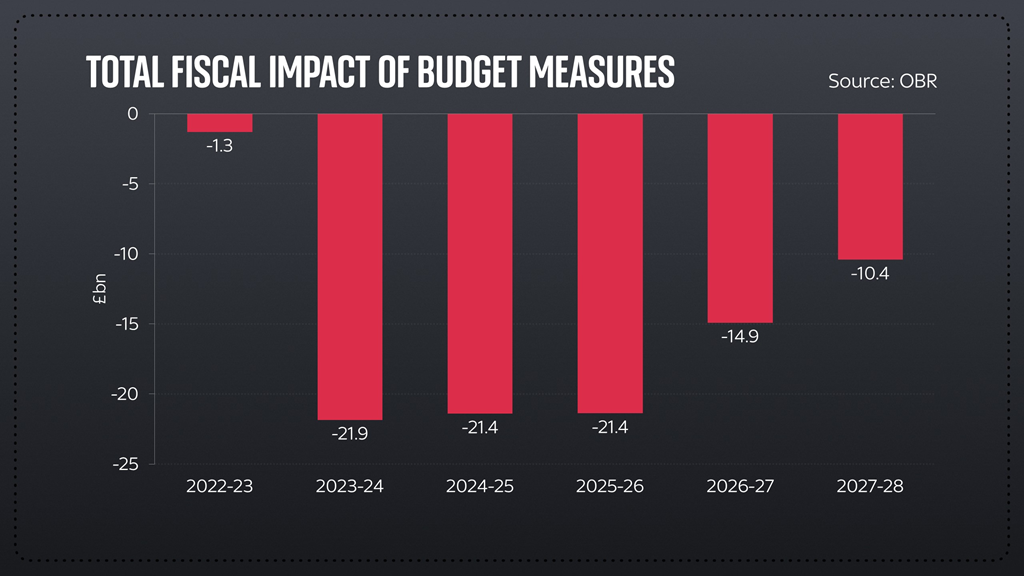
Conway then turned to the total fiscal impact of budget measures from 2022 to 2028, using data supplied by the Office for Budget Responsibility.
He said: “This is the overall amount of money that is going into the economy from the exchequer in each of these years. There are a couple of things to note here.
“There are three years where these bars are very big – lots of money going out.
“Actually, about half of each of these bars is that full expensing policy.
“If you’re a business, you’re basically able to offset more of the money you’re investing against your tax bill in the future. It’s definitely a big deal – it’s definitely expensive.
“But look at how in 2026 and 2027, which of course is after the next election, these bars get smaller. This is because it’s only a temporary policy.”
Lastly, Conway looked at one thing that wasn’t mentioned in the budget today: interest rates.
“An awful lot is happening with interest rates right now,” he said.
“There’s a lot of concern about what’s happening in the financial markets.
“It’s worth just noting this because when it comes to the cost of living crisis, interest rates is a big part of it – and last August they were expecting to go up not very much.
“Then you had the mini budget where the expectation was they would go up to 6.5%.
“As of last week, they’re expected to go to 4.75% in the coming month.
“However, in the last few days alone, this has fallen to an expectation of 4.1%.
“It might well be that the Bank of England has already hit the peak.”
Copy link
1h ago
11:47
Pregnant Then Screwed welcomes childcare changes – but stresses industry in trouble
The founder of Pregnant Then Screwed has welcomed the chancellor’s increased funding for childcare.
In his budget today, Jeremy Hunt announced 30 hours of free childcare for children aged over nine months with working parents by September 2025, and committed to increasing funding for nurseries providing free childcare to £288m.
Joeli Brearley told Sky News her charity, which campaigns against discrimination suffered by women with children, was “really pleased” to see a “significant investment” in the childcare sector.
“We are so happy. It will make an enormous difference to parents who were really struggling to afford those eye-watering fees.”
But she said there is still concern that carers are leaving the industry “in droves”, and that waiting lists are “out of control”.
She added that funding must meet demand: “There’s no point in rolling out free hours if we don’t actually ensure that the providers can deliver them.”
Ms Brearley suggested there is a systemic lack of funding for the early years of a child’s life and that women are expected to do it for free.
Copy link
1h ago
11:40
Chancellor’s plans to incentivise science innovation get lukewarm response
By Paul Kelso, business correspondent
The chancellor made much of his ambition to make the UK a “science superpower”, but the measures he announced to incentivise innovation failed to convince the entrepreneurs and early-stage drug developers in Bristol I watched the speech with.
Tax credits for research and development are crucial to life science companies, who typically see 90% of their innovations fail, take a decade to get a drug to market, and are “pre-revenue”, meaning they spend and lose money rather than make it.
The autumn statement cut R&D tax credits from an effective rate of 33% to 18%, a move that caused consternation among the very industries the government says it wants to incentivise.
Today the chancellor announced a qualified improvement, splitting the difference with a rate of 27% but only for companies that spend 40% or more of total expenditure on R&D.
At Science Creates in Bristol more than 20 life science start-ups share laboratory and office space, in what founder Harry Destecroix calls a “deep-tech ecosystem”.
As well as facilities to develop their innovations it provides funding investment through a venture capital arm.
Mr Destecroix said R&D credits were central to “de-risking” those investment decisions and described the budget as a missed opportunity.
“It feels like the emphasis has been on AI and digital technology, rather than life sciences.”
Donna Gallagher, finance manager of CytoSeek, which is developing cancer cell therapies, said the measure was “disappointing” and “underwhelming not to get back to the same level as before the autumn budget”.
Imophyron are working on new vaccine technology, developing potential treatments for chickungunya and RSV, a respiratory condition.
It has eight staff, has raised £4m and no immediate prospect of turning a profit.
Chief executive Richard Bungay said the R&D measure did not go far enough, and meant the UK would be less attractive “in a very challenging financing environment”.
Copy link
2h ago
11:35
Hunt’s challenge is whether voters will feel the benefits fast enough
Just six months ago, the economy was on the brink, with markets concerned that the UK would not be able to pay back its spiralling obligations. Debt costs were rising.
Yet fast-forward to today, and Jeremy Hunt delivered another heavy spending budget – dolling out £21bn a year, funded by yet more borrowing, taking the chancellor to within a whisker of breaking his fiscal rules.
Meanwhile, one of the centrepiece measures – abolishing the limit of tax-free pension savings – will help a tiny number of just the very richest.
It is the kind of measure that did such damage to the Truss administration in September, even if the scale is smaller.
The two biggest winners in today’s budget were companies that benefit from measures to soften the corporation tax rises by offering £9bn in tax breaks, and future working parents of one and two-year-old children who, by 2025, will be able to access 30 hours of free childcare a week.
However, the outlook on living standards still looks bleak, and there’s no end in sight when it comes to the issue blighting lives today – public sector strikes.
It will be interesting to see how quickly people feel the effects of today’s budget themselves.
You can read more of deputy political editor Sam Coates’ analysis here: