






POLITICSJORDAN
Gaza: Arab countries unwilling to assume future control
Kersten Knipp
16 hours ago16 hours ago
Many Arab states are at least reluctant to have a hand in the political future of the Gaza Strip after a possible end to the rule of Hamas. Yet joint efforts could have advantages for the entire region.
https://p.dw.com/p/4ZMcP
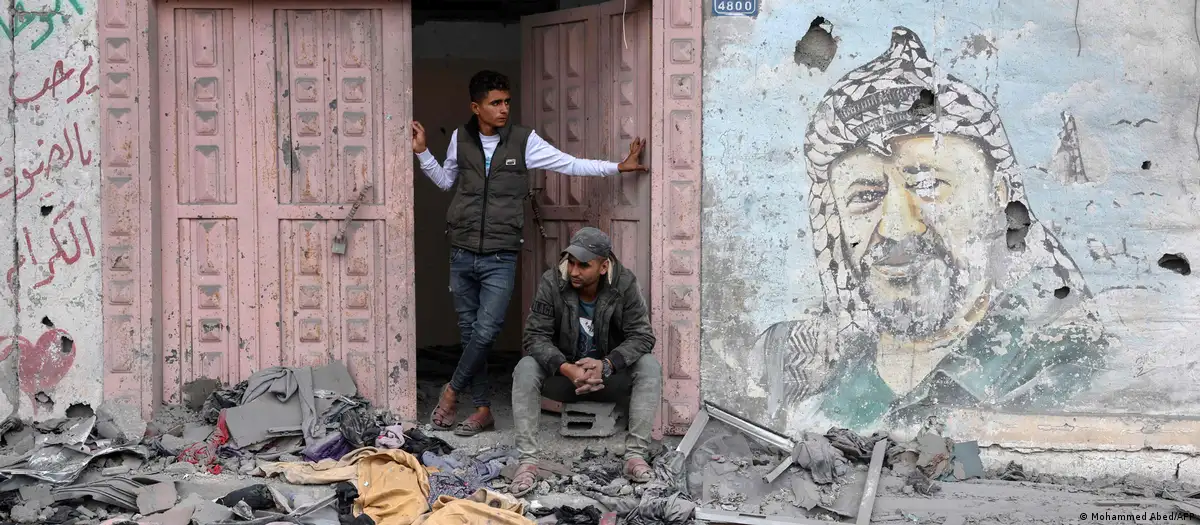
Palestinians stand next to a mural of late Palestinian leader Yasser Arafat amidst the debris following Israeli bombardment on Rafah
Arab states in the region are reluctant, if not unwilling, to have control over Gaza, which will need massive investment once Israel’s war against Hamas endsImage: Mohammed Abed/AFP
Jordan’s Foreign Minister Ayman Safadi did not mince his words during the Manama Dialogue of the International Institute for Strategic Studies.
“All of us have to speak loud and clear about the catastrophe that the Israeli war is bringing, not just on Gaza, but on the region in general,” he said in Bahrain in mid-November.

Safadi’s words highlight that even those Arab states that have diplomatically recognized Israel are currently distancing themselves from its military response to the Hamas terror attack on October 7. The fact that Hamas is classified as a terrorist organization in Germany, the European Union, the US and elsewhere, however, does not seem to play a major role.
The solidarity that Arabs feel for the Palestinians in the Gaza Strip — especially in view of the high and rising death toll — outweighs this far-reaching classification.
Focus on Palestinian plight
However, Arab states have also made it clear they are unwilling to play a part in establishing a new political order in the Gaza Strip after the end of the war, which is not yet foreseeable.
Arab states are not prepared to let Israel have its way and then “come and clean the mess after Israel,” stressed Safadi.
Representatives of the United Arab Emirates and Saudi Arabia have expressed similar views.
One factor in their reluctance is the question of security, and whether Israel will really succeed in destroying Hamas and rendering it harmless.
Palestinians search for casualties at the site of Israeli strikes on a house in Rafah in the southern Gaza Strip November 22, 2023Palestinians search for casualties at the site of Israeli strikes on a house in Rafah in the southern Gaza Strip November 22, 2023
Palestinians in Gaza have endured weeks of Israeli bombardmentImage: Bassam Masoud/REUTERS
Accepting political or even military responsibility in the Gaza Strip, where Hamas structures, or at least sympathy for the terrorist organization could possibly persist among the population, would put Arab countries in an extremely delicate situation.
Jordan’s foreign minister therefore does not see the responsibility for the Palestinian territory’s political future with Jordan or other Arab nations.
“Let me be very clear,” said Ayman Safadi, “there will be no Arab troops going to Gaza. None. We’re not going to be seen as the enemy.”
Ambivalent attitude
“It is no coincidence that the Jordanian foreign minister is particularly vocal about his reservations,” Nicolas Fromm, a political scientist at the Helmut Schmidt University in Hamburg, told DW. “Jordan has had a peace treaty with Israel for a long time and the two countries have been working together in many ways for which the kingdom has been widely criticized in parts of the Arab world.”
Other Arab states, especially those in the Gulf, are likely to be in a similar situation. Some of them, such as the United Arab Emirates and Bahrain, only concluded normalization agreements with Israel a few years ago. Others, such as Saudi Arabia, maintained good, albeit unofficial, relations with Israel until the beginning of 2023. They, too, are now likely to find themselves in hot water, as parts of the population are opposed to this course, Fromm said.
“The Palestinian question continues to play a major role in the Arab world and has great emotional and political mobilization potential,” Eckart Woertz, director of the Hamburg-based GIGA Institute of Middle East Studies, told DW.
The public mood cannot be ignored by those in power, he added.
But at least some Gulf states are likely to have a rather ambivalent attitude towards Hamas, he said.
“After all, it is an offshoot of the Muslim Brotherhood, which is considered a terrorist organization in Egypt, Saudi Arabia and the Emirates,” Woertz told DW.
Therefore, these countries’ governments might be quietly pleased if Hamas was neutralized in the Gaza Strip, or at least restricted in its scope.
Financial restraint
A further major challenge for the time after the war will be financial aid. Gaza, which has been blockaded by Israel and Egypt on and off for years, is unlikely to manage rebuilding its infrastructure on its own.
“But no one, neither Israel, nor America, nor the Arab states or Palestinian leaders, want to take responsibility,” summarized the London-based business magazine The Economist after the meeting in Manama.
“They have already rebuilt Gaza several times,” the article quotes an unnamed Western diplomat as saying. If the reconstruction of the Gaza Strip “is not part of a serious peace process, they will not pay.”
Middle East expert Woertz considers a lasting political solution, specifically a two-state solution with East Jerusalem as capital of a Palestinian state, to be the minimum prerequisite for a possible subsequent Arab involvement in the reconstruction of the Gaza Strip.
“You can’t just rebuild every few years and then destroy it again,” he said. “The European Union and the Gulf states probably have a similar view.”
A view of the British-owned and Japanese-operated cargo ship Galaxy Leader, which was reported to have been captured by Houthis in the southern Red SeaA view of the British-owned and Japanese-operated cargo ship Galaxy Leader, which was reported to have been captured by Houthis in the southern Red Sea
Iran-backed Houthi rebels hijacked the Bahamas-flagged Galaxy Leader as it sailedin the northern Red Sea, taking 25 crew members hostageImage: Owen Foley/REUTERS
Fear of escalation
According to the online magazine Al-Monitor, which focuses on the Middle East, the political elite of the Gulf states are also keen on keeping the conflict out of their own region. They are pinning their hopes on the war coming to an end at some point, Al-Monitor wrote.
However, this is by no means guaranteed. Iran-backed militias such as Hezbollah in Lebanon, pro-Iranian groups in Iraq, and the Houthi rebels in Yemen could escalate the conflict even further, as could Iran itself. Just a few days ago, for example, the Houthis captured a cargo ship in the Red Sea because of its links to Israel.
“The threat of an escalation of the conflict could conversely also be a motivation for some Arab countries to become more involved in finding a solution, for the sake of their own security,” said Nicolas Fromm, adding that no matter what a political solution would look like, it would have to focus not least on providing the Palestinians with an appropriate perspective.
“If that doesn’t succeed, there will continue to be frustration, anger and therefore violence,” he said.
Jennifer Holleis adapted this article from German.
Hopes for release of 3-year-old girl taken hostage by Hamas
01:52
Kersten KnippKersten Knipp
Kersten Knipp Political editor with a focus on the Middle East