







TECHNOLOGYCharted: The Rise of Mobile Device Subscriptions WorldwidePublished 3 weeks ago on October 18, 2022
By Pablo Alvarez green checkmark iconFeatured Creator
Article/Editing:
Carmen Ang
Tweet
Share
Share
Reddit
Email
Charting Two Decades of Mobile Phone Subscriptions
Charting The Rise of Mobile Device Subscriptions Worldwide
There were approximately 8.6 billion mobile device subscriptions worldwide as of 2021, more than there are people on the planet.
Yet, while mobile phones, tablets, and other devices have become extremely common across the globe, access still varies greatly from country to country.

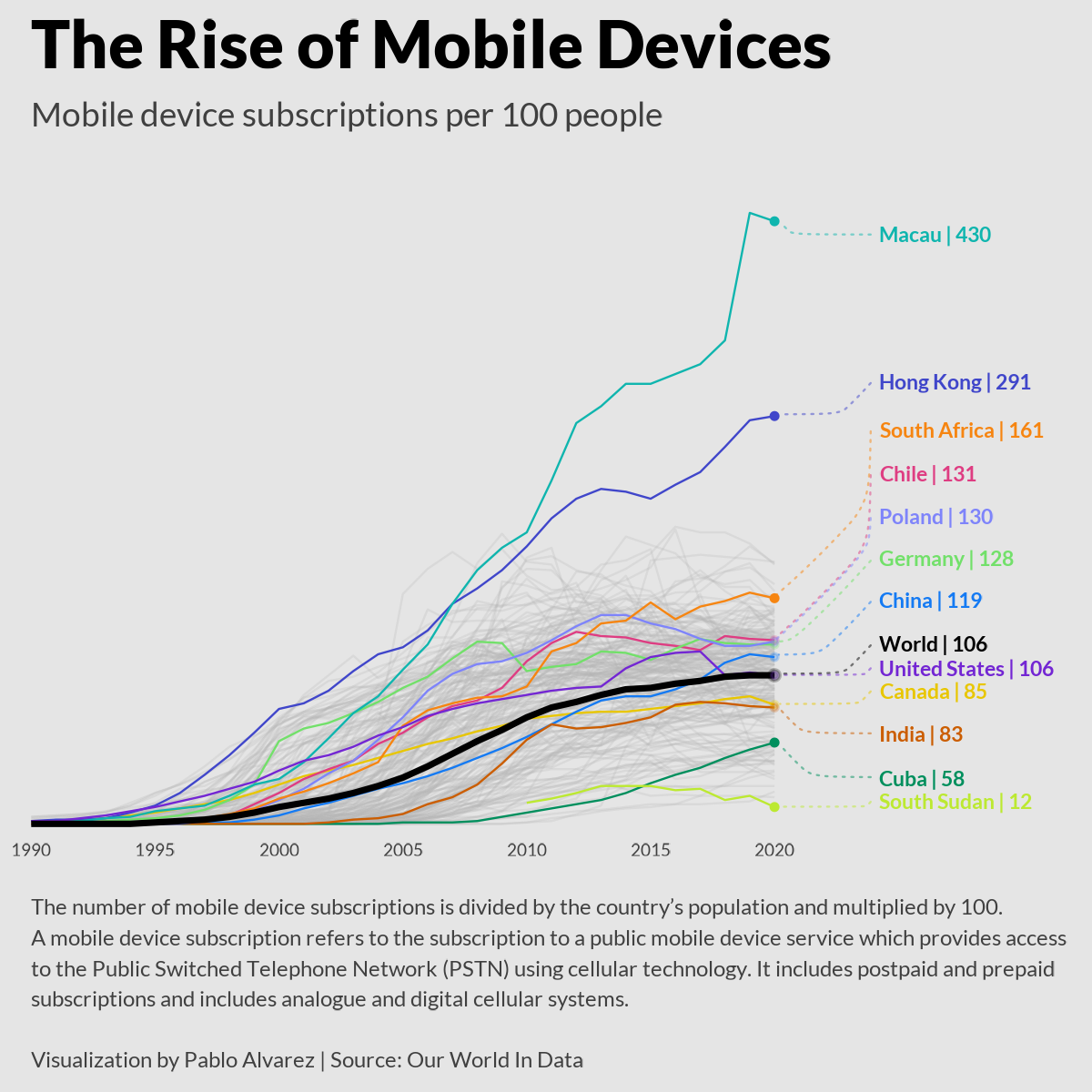
Using data from Our World in Data, this chart by Pablo Alvarez tracks the rise of mobile phones across the globe, showing the discrepancies in mobile phone subscriptions in select countries.
The Evolution of the Mobile Market
Before diving into the present-day divide, it’s worth quickly explaining how the overall cell phone market and mobile devices in general have evolved over the last three decades.
Below is a summary of the history of the mobile market since its onset in the early 90s.
The 90s and Early 2000s: The Beginning
The first mobile device hit the market in 1983, with Motorola’s launch of the DynaTAC 8000X. This clunky analog phone cost nearly $4,000 and needed to be recharged after 30 minutes of use.
By the early 1990s, innovation in the industry had somewhat taken off, with various manufacturers like Nokia and Sony starting to launch their own devices.
While this gave consumers more product options to choose from, the technology was still fairly new, and mobile adoption was relatively low compared to today’s figures.
2007 and Onwards: Apple Opens Up the Market
Though many companies introduced mobile phones, and a few launched early tablet devices like the PalmPilot and the Nokia 770, it was Apple’s foray into the market that shook things up.
The iPhone’s launch in 2007, and the iPad’s debut in 2010, ushered in a new era of mobile devices. Their touch-screen design was revolutionary at the time, and they were also exceptionally more functional through the App Store, since users could download hundreds of different mobile applications and games quickly.
This is when the rise of mobile really started to pick up across the globe. In 2007, there were nearly 3.4 billion mobile device subscriptions worldwide or about 50% of the global population.
Present Day: Mobile Devices Are Common, But Not Ubiquitous
In many parts of the world, millions of people rely on their mobile phones and tablets every day for work, social life, or simple day-to-day activities like figuring out directions or deciding what to make for dinner.
Yet, while overall mobile subscriptions have surpassed the global population, adoption hasn’t been equally spread across the globe.
Here’s a look at mobile device subscriptions per 100 people, in 12 different regions:
Search:
Country Mobile Subscriptions Per 100 People (2020)
🇲🇴 Macau 430
🇭🇰 Hong Kong 291
🇿🇦 South Africa 161
🇨🇱 Chile 131
🇵🇱 Poland 130
🇩🇪 Germany 128
🇨🇳 China 119
🇺🇸 United States 106
🇨🇦 Canada 85
🇮🇳 India 83
PreviousNext
As the table above shows, some regions have a lot more mobile phone subscriptions than people, while other places are lagging behind.
In regions with a surplus, people likely have multiple devices and SIM-enabled gadgets like smartwatches and connected cars. This explains how in Macao, mobile subscriptions are more than 300% higher than the country’s population.
On the flip side, in South Sudan, there are just 12 mobile phone subscriptions for every 100 people in the country. Poverty is widespread across the country, which helps explain its relatively low number of mobile subscriptions. According to the World Bank, only 7.2% of the South Sudan’s population has access to electricity.
green check mark icon
This article was published as a part of Visual Capitalist’s Creator Program, which features data-driven visuals from some of our favorite Creators around the world.