




Politics latest: Rishi Sunak defends home secretary’s use of term ‘invasion’ to describe small boat crossings as he faces senior MPs
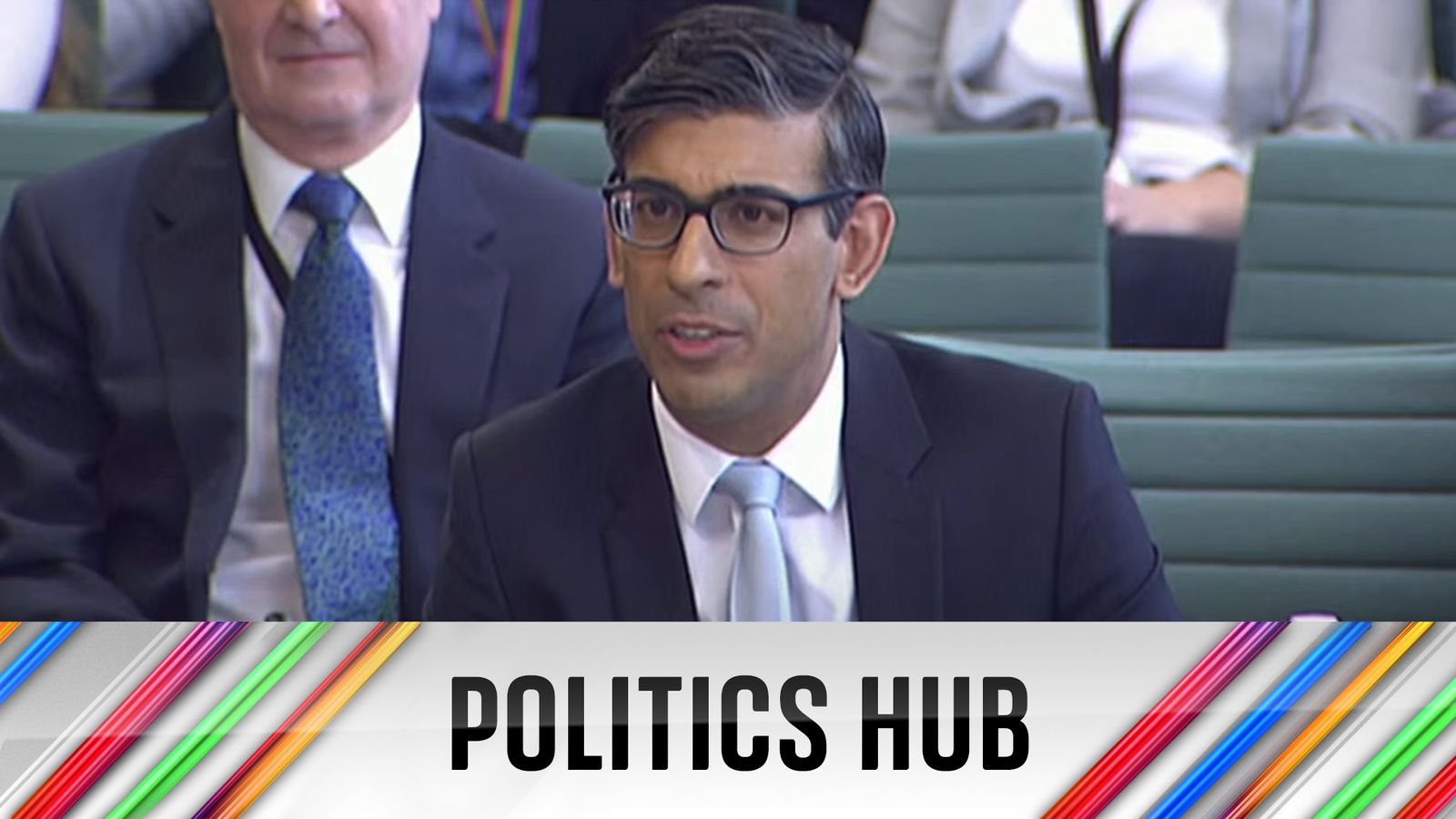
Rishi Sunak faces questions on a wide range of topics as he appears in front of the Liaison Committee of senior MPs.
Rishi Sunak
Image:
Rishi Sunak fields questions as he appears in front of the Liaison Committee of MPs
Why you can trust Sky News
Key points
Rishi Sunak defends home secretary’s use of phrase ‘invasion’ to describe small boat crossings as he faces senior MPs View post
PM stands by detention of children to avoid ‘pull factor’ View post
Sunak also confirms HS2 will end at Euston station after delays and uncertainty View post
Jon Craig: PM successfully giving answers that reveal absolutely nothing – despite MPs’ best efforts to trip him up View post
Jeremy Corbyn says he has ‘no intention of stopping’ representing constituents after being blocked from standing for Labour View post
Humza Yousaf elected first minister of Scotland View post
Live reporting by Sharon Marris and Alexandra Rogers
Sort by:
LatestSort by latest OldestSort by oldest
12h ago
12:45
Leadership rival rejects post in Humza Yousaf’s cabinet
Sky News understands Scotland’s new first minister offered defeated leadership rival Kate Forbes a demotion, which she has rejected.
She was finance secretary under Nicola Sturgeon, but Mr Yousaf wanted to move her to the rural affairs brief.

However, she has turned down the move and will be leaving government.
You can read more here:
Kate Forbes leaves Scottish government after rejecting demotion from new first minister Humza Yousaf,
Sky News
Copy link
12h ago
12:37
Jeremy Corbyn says he has ‘no intention of stopping’ representing his constituents
“The NEC’s decision to block my candidacy for Islington North is a shameful attack on party democracy, party members and natural justice,” Mr Corbyn says in the wake of Labour’s NEC banning him from standing for the party at the next election.
“When I was leader of the Labour Party, I was determined to build a member-led movement that gave hope to a new generation.
“Today’s disgraceful move shows contempt for the millions of people who voted for our party in 2017 and 2019, and will demotivate those who still believe in the importance of a transformative Labour government.
“Now, more than ever, we should be offering a bold alternative to the government’s programme of poverty, division and repression. Keir Starmer has instead launched an assault on the rights of his own Labour members, breaking his pledge to build a united and democratic party that advances social, economic and climate justice.
“I will not be intimidated into silence.
“I have spent my life fighting for a fairer society on behalf of the people of Islington North, and I have no intention of stopping now.
You can read more on the NEC’s move here in this piece from political reporter Faye Brown:
Jeremy Corbyn formally blocked from running as a Labour MP at next election
Sky News
Copy link
12h ago
12:30
Labour brings in right to appeal for spurned candidates at parliamentary selections
Exclusive by Alexandra Rogers, political reporter
Candidates who wish to stand for Labour at the next election will be given the right to appeal if the party rejects their bid to become an MP, Sky News can reveal.
Labour has faced accusations of fixing parliamentary selections for candidates who are preferred by the leadership while using “due diligence” checks to bar others for political reasons and on spurious grounds – a charge the party has denied.
It comes after it was again confirmed that former leader Jeremy Corbyn will not be allowed to even seek the Labour nomination ahead of the next general election – meaning this right to appeal will not apply to him.
You can read more here:
Labour brings in right to appeal for spurned candidates at parliamentary selections
Sky News
Copy link
12h ago
12:15
Humza Yousaf elected by MSPs as Scotland’s new first minister
Humza Yousaf has been officially elected as Scotland’s new first minister after he was backed by a majority of MSPs.
Following his victory in the SNP leadership race on Monday, the 37-year-old faced a vote at Holyrood to confirm him as Nicola Sturgeon’s successor.
Opposition parties were able to put themselves forward in the process, but with the backing of the Greens – as well as his own SNP members – Mr Yousaf successfully saw off challenges from Scottish Conservative leader Douglas Ross, Scottish Labour leader Anas Sawar and Scottish Liberal Democrat leader Alex Cole-Hamilton.
It means Mr Yousaf’s name will now be submitted to the King, with a formal session to swear him in expected at the Court of Session in Edinburgh on Wednesday.
You can read more from political reporter Faye Brown here:
Humza Yousaf elected by MSPs as Scotland’s new first minister | Politics News | Sky News
Sky News
Copy link
Advertisement
12h ago
12:13
Windsor Framework a ‘fantastic foundation’ for Northern Ireland, says Sunak
The PM has been banging the drum for the Windsor Framework – the new Brexit deal that was formally signed off with the EU last week – but not everyone is a fan.
Sir Bill Cash, a veteran Eurosceptic, makes it known that he’s “not very keen” on the Windsor Framework.
Sir Bill claims that the agreement, which replaces the original Northern Ireland protocol negotiated by Boris Johnson, damages the union of the UK.
Mr Sunak replies: “On that, Bill, I will have to respectfully disagree.”
He goes on to say he believes the agreement is the “right thing” for the people of Northern Ireland and that it represents a “fantastic foundation for us to move forward”.
Copy link
12h ago
12:02
A safety-first performance from the PM
The face of the inscrutable Nicholas Howard, the civil servant sitting behind Rishi Sunak, finally breaks into a beaming smile and he almost – only almost – chuckles.
The reason: some typically knockabout banter between the SNP MP Angus MacNeil and Mr Sunak about Scottish independence Brexit, in which – it’s fair to say – they agree to differ.
And as the session draws to a close, Sir Bernard asks him about his Rwanda deportation scheme and the PM tells him: “We will get fights to Rwanda as soon as we can after the legal proceedings have been completed.”
Which is as vague as some of Mr Sunak’s answers at the beginning of the hearing.
We’re still none the wiser on the Rwanda policy: numbers or timetable.
And from that, the session moves towards an energy-sapping anti-climax as Sir Bill Cash claims the Windsor Framework damages the Union of the UK, to which Mr Sunak replies wearily: “On that, Bill, I will have to respectfully disagree.”
Sir Bernard then wraps up proceedings by asking what happens if powersharing in Northern Ireland is not restored.
But Mr Sunak ends the session as he began it, by ducking the question.
He says he hopes it is restored, prompting Sir Bernard to say that if it isn’t, the Northern Ireland Protocol will have to be replaced by something that has the confidence of both parties.
At last, a bold statement from someone in the room.
After his starring performance at last week’s privileges committee, Sir Bernard has been on good form again here.
Mr Sunak, on the other hand, after a safety-first performance, has done just enough to get through the hour and three-quarters of questions without making any gaffes or blunders or giving much away.
Job done, then.
Copy link
13h ago
11:45
‘I think we did have a referendum on it’: PM challenged on Scottish independence
Mr Sunak says he has not yet spoken to the new first minister of Scotland but is “looking forward” to this.
Then he is asked about the prospect of Scottish independence and a Section 30.
A Section 30 allows Holyrood to pass laws in areas that are normally the domain of Westminster.
It has been used 16 times since the Scottish Parliament was created in 1999 – one of those times was ahead of the last independence referendum in 2014.
If used for another independence referendum, it would mean the results are seen as legitimate.
Angus MacNeil from the SNP asks the PM: “If you don’t grant that Section 30, it may be that you don’t want Scotland to have a referendum and, in that case, why would you prefer Scotland to go to an election route for independence rather than the referendum route?”
The PM replies: “I think actually what people in Scotland want is to see the two governments working together to deliver for them.
“I was pleased that one of the last things I was able to do with the previous first minister was announce two new freeports in Scotland… a good example of that cooperation, delivering jobs, opportunities.”
Mr MacNeil says if the people in Scotland at the ballot box speak for independence or not, shouldn’t it be respected?
The PM says: “I think in an election people vote on all sorts of things and I don’t think it’s appropriate to try and hijack a general election…”
“I think we did have a referendum on it – we did… we were told it was a once-in-a-generation referendum.
“But as a result, Scotland had an opportunity to express their views and they did, so I don’t think anyone could deny that they were given that choice.”
Copy link
13h ago
11:39
Sunak defends the word ‘invasion’ to describe small boat crossings
Home Affairs Select Committee chair Dame Diana Johnson is now questioning the PM over his small boats policy.
She links the issue to the recent report into the Metropolitan Police by Dame Louise Casey, which concluded that there was “institutional” racism, misogyny and homophobia at the force.
In response to the findings, Home Secretary Suella Braverman said she believed the word was “not a helpful term to use” – arguing that it was “ambiguous, contested and politically charged”.
Dame Diana asks the PM why it is “politically charged” to use the term “institutional racism” but not “invasion” – as the home secretary has to describe small boat crossings.
The prime minister defends the use of the word and says the problem is significant and is growing.
During questioning on migration, Mr Sunak also rowed back from suggestions that flights carrying migrants to Rwanda will take off this summer.
“We will get flights to Rwanda as soon as we can after the legal proceedings have been completed.”
UK officials working on starting deportation flights to Rwanda ‘by summer’
Sky News
Copy link
13h ago
11:34
PM’s grasp of detail starting to falter
As we pass the hour mark, Rishi Sunak’s grasp of detail begins to falter, first on childcare, then on refugees and overseas aid policy.
Labour’s Catherine McKinnell attempts to pin the PM down on childcare detail, but only receives broad brush answers about policy.
Then Caroline Nokes, one of the government’s most persistent Tory critics, turns to child refugees. But the PM is defiant about his small boats policy.
But the lowlight of the committee so far comes when Simon Hoare, who chairs the Northern Ireland Select Committee, is guilty of shocking toadyism towards the prime minister.
He tells Mr Sunak he would have been the first MP “trampling all over you” in the lobby to vote for his Windsor Framework. Not what we expect at the Liaison Committee.
That’s the sort of crawling to a party leader that gets an MP a government job. And ridicule from colleagues!
Copy link
13h ago
11:23
PM challenged over using foreign aid budget to look after refugees at home
Sarah Champion, chair of the International Development Select Committee, asks Mr Sunak about foreign aid.
She asks why the Treasury has not been asked to ringfence a specific amount to support refugees in the UK instead of raiding the foreign aid budget.
Mr Sunak says: “We act in line with the DAC [OECD Development Assistance Committee] rules – we’re completely in compliance with all of those and we provided, I think, an additional £2bn… we remain one of the leading spenders on international development anywhere in the world.”
Earlier, Ms Champion asked him: “You just said that you support refugees coming here.
“I think that’s absolutely the right thing to do, but you’re using the aid budget to do it, and in doing so you’re effectively turning your back on the poorest in the world by not addressing the very drivers that forced them to flee their homes. So how is that approach fair?”
Mr Sunak says: “The way in which we spend our aid money is entirely in line with the OECD… the autumn statement last year made additional money available to deal with the particular circumstances of Ukraine and also Afghanistan, but primarily Ukraine.”
Ms Champion says: “Yes, it’s within the guidelines, but it’s not within morality… it has immense strain on our support for fragile countries in the world.”
She raises the example of a Save The Children programme in Afghanistan that had its UK government funding cut “at very short notice”. She says this project had been supporting 100,000 women and girls – “they’re not going to have to wind that project up”.
“Why are you cutting aid to Afghanistan when the country is undergoing such a massive humanitarian crisis?”
Mr Sunak – for at least the third time – says the UK is “one of the largest spenders on aid in the world” with a “very very strong track record”.
“And with regard to Afghanistan in particular, you know we are a leading donor to the situation in Afghanistan – I think we’ve committed something like £200m since spring of last year, at least.”
Copy link
13h ago
11:17
Sunak defends detention of children to avoid ‘pull factor’ in small boat crossings
The prime minister is now being asked about his policy to tackle small boat crossings in the Channel.
Rishi Sunak defends the provisions of the Illegal Migration Bill, which says that people arriving on small boats will be detained within the first 28 days without bail or judicial review before being deported.
Critics have raised alarm that under the bill, the government will have the power to deport unaccompanied children when they turn 18.
Caroline Nokes, the Tory chair of the Women and Equalities Committee who has spoken out against the policy, asks whether children will be separated from their families.
Mr Sunak insists the intention of the policy is “not to detain children” but says the new detention rules must not exempt children in order not to create a “pull factor”.
“The intention of this policy is not to detain children, but it’s important that we don’t inadvertently create a policy that incentivises people to bring children who wouldn’t otherwise come here,” he says.
“Otherwise you create an incentive for a criminal gang to bring a child with them when they otherwise wouldn’t be, and I don’t think that is a good thing.
“We don’t want to create a pull factor to make it more likely that children are making this very perilous journey in conditions that are appalling.”
Copy link
13h ago
11:04
Sunak promises ‘rapid increase’ in childcare funding
Rishi Sunak is now asked about childcare, after the government recently announced 30 hours of free care a week for children between nine months and two.
Some campaigners have raised concerns that there will not be enough staff available to fulfil demand.
Mr Sunak says the changes to the required ratio of childcare workers to children “will help ensure that there’s actually potential for more competitively provided childcare, bringing us in line with our peers”.
He says that, in terms of the rollout of extra provision, there will be a “very rapid increase in the funding rate for existing programmes”.
“And that’s happening relatively quickly,” he adds.
When asked about the challenge of getting enough childcare workers to supply these ratios when pay and retention are an issue, he says: “These are policies that are targeted at improving the supply of childminders so that we can increase provision of childcare, which is something that I think everyone wants to see.
“So I think it is a totally reasonable thing to do.”
Copy link
14h ago
10:47
The inscrutable civil servant sitting behind PM as he fields MPs’ questions
After some good-natured banter with Meg Hillier over getting government cash to the NHS and other frontline services more quickly, Rishi Sunak faces some forensic questions from Iain Stewart, who chairs the Transport Select Committee, on HS2.
And finally, after half an hour of questions, the PM gives a straight answer to a question. “Yes,” he says, answering Mr Stewart’s question on whether HS2 will go from Old Oak Common, west of London, to Euston. He didn’t say when, of course.
Other MPs then jump in on HS2, with Meg Hillier and Sir Bernard Jenkin warning that delay will end up costing taxpayers more, not less, money. A view shared by many MPs of all parties.
And now, a public service announcement! It can be revealed that throughout all this, sitting inscrutably and patiently behind Mr Sunak, a bid like a weary passenger waiting for a late train, is Nicholas Howard, a veteran Downing Street civil servant.
Not Sir Humphrey. Plain Mr Howard, but highly respected. He’s been preparing prime ministers for PMQs in the Commons and Liaison Committee appearances since Tony Blair was prime minister.
Alastair Campbell, Mr Blair’s director of communications, previously described Mr Howard as “one of the finest civil servants I ever worked with”. Praise indeed.
Copy link
14h ago
10:46
PM makes commitment on HS2 after delays and uncertainty
Rishi Sunak is being asked about HS2 by the Transport Select Committee chair Iain Stewart.
After delays and uncertainty about where the high-speed railway will end, the prime minister makes a commitment.
Asked if it is the intention that HS2 will terminate at Euston station in central London, Mr Sunak says “yes” and adds: “It shouldn’t be ambiguous.”
Earlier this month, the government announced that the construction of sections of HS2 would be delayed by two years to save money.
HS2 was initially set to link London and the West Midlands with a further phase extending to cities in the North.
Michael Gove was unable to confirm that the tracks linking Old Oak Common and Euston station would ever be built and refused to guarantee that HS2 will terminate at Euston.
Mr Sunak doesn’t say when the Euston link will be completed, but adds: “I think this gets back to this affordability and profiling issue over the next couple of years. And I think the aim is to deliver… that station alongside the rollout to Manchester and to take the time now to get the right deliverability for that particular section.”
Meg Hillier takes the PM to task over the issue, asking if Britain “just can’t get on with delivering big infrastructure projects”.
Mr Sunak replies: “I think it’s important that we get the big infrastructure projects right, that we do them properly. They cost lots of money. It’s reasonable that we make sure they’re going to be done on budget.”
You can read more about the cost of HS2 delays here:
Euston HS2 delays would mean extra costs and higher spending, watchdog warns
Sky News
Copy link
14h ago
10:32
Sunak: ‘We’ve struck the right balance’ on health workers’ pay settlement
Steve Brine, chair of the Health Select Committee, asks the prime minister about the recent pay settlement with health workers and how it will be funded.
Earlier this month, NHS unions reached a pay deal with the government – a one-off payment of 2% of their salary plus a COVID recovery bonus of 4% for the current financial year 2022/23, and a 5% pay increase for 2023/24.
It applies to NHS workers such as nurses and paramedics – but not junior doctors, who are in a different dispute.
Mr Sunak says “we’ve struck the right balance” between paying workers “fairly” for the “fantastic” work they do, and making sure the pay deal was affordable to the taxpayer and “consistent with our promises to halve inflation and cut the waiting list”.
Mr Sunak does not give any specifics when asked where the money will come from, saying he doesn’t want to get in the middle of conversations between departments and the Treasury.
The PM says efforts to clear the COVID backlog in hospitals are “broadly on track”, despite admitting the waiting list is up to about seven million people.
The first target – to eliminate the two-year wait for elective surgery – was “practically done last year”, he says. The next target – to eliminate the one-and-a-half-year wait – is set for spring “and we’re broadly on track for that”.
“And then the target after that is to practically eliminate the 52-week wait as by around spring of next year.”
He says strikes by junior doctors are making clearing the backlog “harder” and adds that future walkouts may continue to have an impact.
Copy link
14h ago
10:23
PM so far succeeding in giving answers that reveal absolutely nothing
Sir Bernard Jenkin springs a surprise by beginning the Liaison Committee hearing by asking Rishi Sunak about Ukraine – which wasn’t on the advance agenda – and the outcome or outcomes favoured by the UK.
The PM ducks that, saying that’s a matter for Ukraine.
He also bats away a question about UK funding and resources for Ukraine and gives a bland answer about the summit between Vladimir Putin and China’s President Xi.
Sir Bernard looks crestfallen. His big moment has flopped.
Then, kicking off on the economy, Harriet Baldwin attempts to tease out of Mr Sunak a pre-election pledge to keep fuel duty down. She also gets nowhere.
So far, the PM is succeeding in giving answers that reveal absolutely nothing.
Mr Sunak is following the Sir Humphrey Appleby playbook from Yes Minister, giving nothing away, aided by a toadying question from Steve Brine, who obsequiously calls the PM “a problem solver”. Mr Sunak smiles.
Copy link
14h ago
10:14
Rishi Sunak questions China’s claim to be ‘neutral party’ in Ukraine war
Sir Bernard Jenkin, the chair of the Liaison Committee, kicks off the session by asking about the prime minister about the UK’s support for Ukraine.
He focuses on the recent three-day visit to Russia by Xi Jinping, the Chinese leader – who claimed the trip was aimed at brokering peace in the Ukraine war through a 12-point plan.
Rishi Sunak says China’s decision to abstain in a UN vote demanding Russia withdraw troops from Ukraine “does little for their credibility as a neutral party in this”.
He adds: “I’d encourage President Xi, as we’ve said, to engage directly with President Zelenskyy [of Ukraine] on any particular peace proposal that China is interested in putting forward.”
Copy link
14h ago
10:01
Humza Yousaf elected first minister of Scotland
Humza Yousaf has been elected first minister of Scotland after winning the SNP leadership contest yesterday.
He has taken over from Nicola Sturgeon.
Mr Yousaf needed to be voted in by MSPs in Holyrood to officially take the role.
He was guaranteed to get the job due to the majority support of SNP colleagues and also the Scottish Greens.
Mr Yousaf received 71 votes, while Scottish Conservative leader Douglas Ross got 31, Labour’s Anas Sarwar got 22 and the Liberal Democrats’ Alex Cole-Hamilton got 4.
Copy link
15h ago
10:00
PM facing senior MPs
Rishi Sunak’s appearance before the Liaison Committee of MPs is under way.
The super-group is made up of the chairs of the various select committees that scrutinise different policy areas.
Mr Sunak will spend 90 minutes facing questions on a range of topics, including:
The budget and economic issues
Brexit
Small boat crossings
In terms of MPs who could cause problems for the PM, Sir Bill Cash, the Conservative backbencher and arch Eurosceptic, is likely to haul his leader over the coals on the recently agreed Windsor Framework – which he voted against.
And Caroline Nokes, who sits on the other flank of the Tories from Sir Bill, will ask the PM on what she has branded his “horrendous” asylum plans.
Harriet Baldwin, the chair of the Treasury Select Committee, will drill down into the detail of Mr Sunak’s economic plans.
Mr Sunak’s last – and first – appearance as PM before the committee was just before Christmas.
Before that, Boris Johnson gave evidence to the group as his government collapsed around him in July.
Copy link
15h ago
09:58
Many MPs on the Liaison Committee will do their best to trip up the normally sure-footed PM
In theory, an appearance before the Liaison Committee ought to be a breeze for Rishi Sunak, a details man who does his homework and is unflappable under pressure.
But this time – his second appearance since becoming prime minister – Mr Sunak may feel the chill wind of MPs out for revenge and intent on settling some old scores.
The agenda for the 90-minute hearing ought to be a doddle for the PM: three issues which his supporters claim have gone well for him in recent weeks – the budget, small boats and the Windsor Framework.
But many of the interrogators lying in wait for Mr Sunak – MPs who chair select committees – have an axe to grind and will be doing their best to trip up the normally sure-footed PM.
The committee is chaired by the veteran eurosceptic Tory MP Sir Bernard Jenkin, fresh from his skewering of Boris Johnson at the privileges committee last week, who’ll be determined to prove he’s no government patsy.
Opening the section on the budget and economic issues, Tory ex-minister Harriet Baldwin, who chairs the Treasury Select Committee, described Jeremy Hunt as a lucky chancellor during the budget debate in the Commons. Not helpful!
Next up is another Tory ex-minister, Steve Brine, who chairs the health select committee but is facing calls from the opposition for his removal after claims he broke lobbying rules during the pandemic.
Then there’s one of the Liaison Committee’s star Labour performers, Dame Meg Hillier. Expect questions to Mr Sunak on child care from her.
In the budget debate she said Mr Hunt was “borrowing Liz Truss’s play book”, claiming: “She was the minister who proposed this ‘pile them high and teach them cheap’ approach to childcare.”
On migrants and small boats, Mr Sunak will face questions from three of the fiercest critics of the government’s policy, Labour’s Sarah champion and Dame Diana Johnson and Tory Caroline Nokes.
Then on the Windsor Framework, leading the onslaught will be the veteran Tory Euro-sceptic Sir Bill Cash. And Brexiteer Bill has got the hump with the prime minister right now.
He called on Mr Sunak to appear before his European Scrutiny Committee, a talking shop for Brexit obsessives.
Not surprisingly, the PM wasn’t going to waste his time on that and sent the Northern Ireland Secretary Chris Heaton-Harris instead.
Sir Bill, who has been an MP since a by-election in 1984, would have known full well that prime ministers don’t appear before bog standard select committees.
That’s why it was decided in 2002, after an offer by Tony Blair, that the Liaison Committee – previously a mostly administrative body – would quiz the PM twice a year.
Boris Johnson, the opposite of Rishi Sunak in terms of details, homework and remaining unflappable – as we saw at the privileges committee last week, did everything he could to avoid turning up at the Liaison Committee, cancelling three appearances at short notice during 2020.
Mr Johnson’s last appearance before the committee, in July last year, was unforgettable, coming during an avalanche of resignations from his government. “The game’s up!” crowed the SNP’s Angus MacNeil during the hearing.
And after Mr Johnson implausibly claimed he was having a “terrific” week, Labour’s Darren Jones told him a delegation of cabinet ministers was waiting in Downing Street to tell him to quit. It was a brutal moment.
No such drama or confrontation awaits Mr Sunak this time.
But he’d be wise not to be too complacent, given the traps the committee members will be waiting to lay for him.