







REPUBLIC OF KOREA
This Asian nation will give families $770 a month for one year to have a baby
Apr 3, 2023
This article is published in collaboration with
Quartz
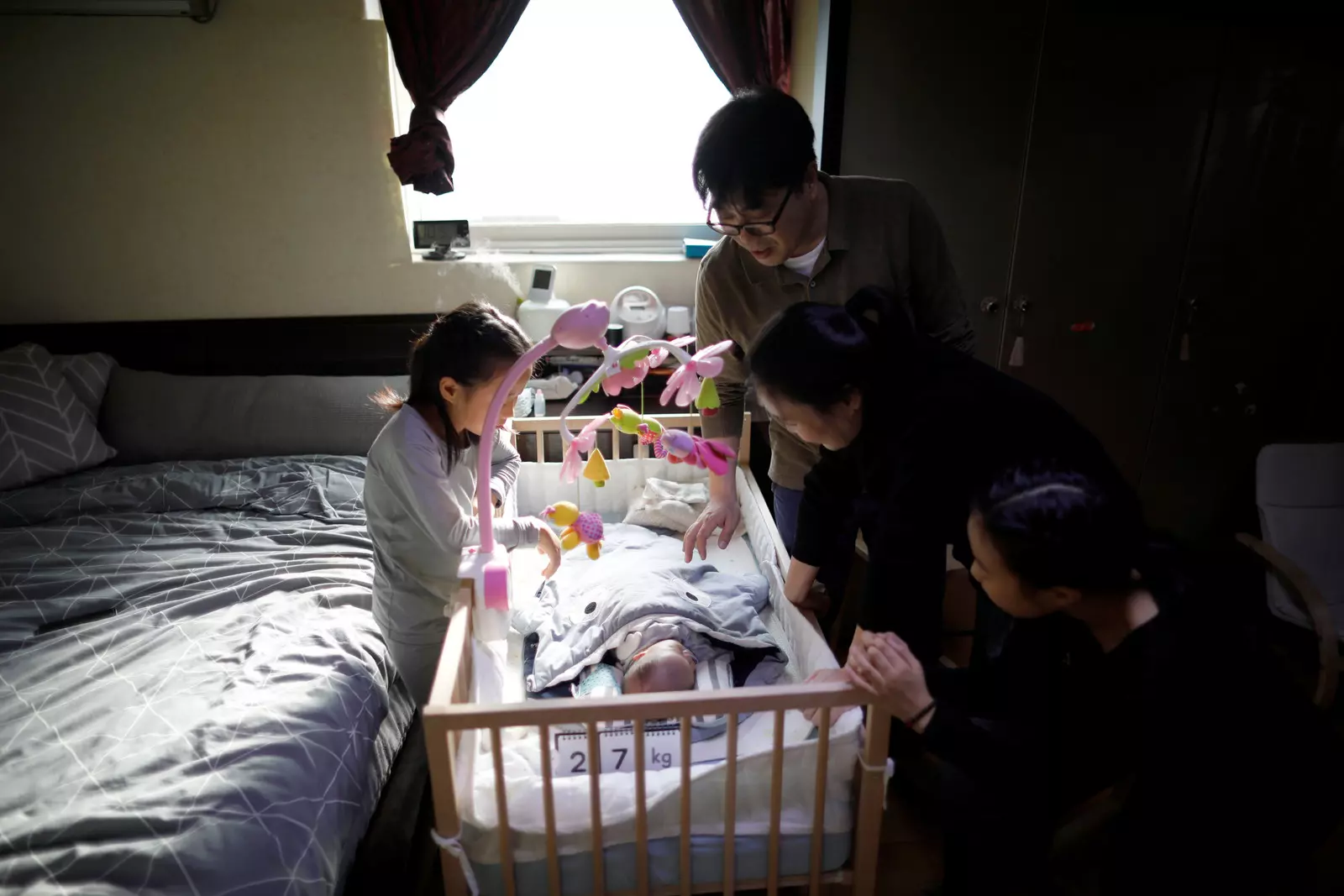
Comparable countries, even those with notoriously low fertility rates, still have larger populations than South Korea.
Image: REUTERS/Kim Hong-Ji

Annalisa Merelli
Senior Reporter, Quartz
Share:
THE BIG PICTURE
Explore and monitor how Republic of Korea is affecting economies, industries and global issues
CROWDSOURCE INNOVATION
Get involved with our crowdsourced digital platform to deliver impact at scale
Stay up to date:
Republic of Korea
South Korea has the lowest growth rate in the world at 0.78.
For countries to maintain a stable population, the birth rate must be 2.1, experts say.
The situation has pushed president Yoon Suk Yeol to propose new measures to encourage South Koreans to have children.
In March, Yoon announced that his government is significantly boosting the monthly allowance already in place for parents of children under a year.
South Korea’s birth rate has reached alarming new lows. Births shrank to 0.78 per woman last year, from 0.81 in 2021, which already put the country lowest in the world. If that trend continues, South Korea’s population will be less than half what it is now by the end of the century.
Comparable countries, even those with notoriously low fertility rates, still rank well above the Asian nation: Spain has 1.23 births per woman, Italy 1.24, and Japan 1.34. To maintain a stable population, the rate must be 2.1.
The situation has pushed president Yoon Suk Yeol to call for an “emergency mindset,” proposing new measures to encourage South Koreans to have children.
Those efforts try to address what seems to be the root cause of hesitancy to procreate: Children are too expensive.
The $770-a-month baby
On March 28, president Yoon announced that his government is significantly boosting the monthly allowance already in place for parents of children under a year. Starting now, that sum will more than double, from 300,000 won (about $230) to 700,000. Another hike in 2024 will bring it up to 1 million won, or roughly $770 per month. The average monthly salary in South Korea was about $3,400 as of December 2022.
This move will further increase the huge investment the country has already made in trying to raise its birth rate. Over the past 16 years, South Korea has spent as much as $200 billion without much to show for it, as fertility has continued its steady decline.
Have you read?
There were more deaths than births in South Korea for the first time last year. Here’s why that matters
Birth rates are shrinking in Japan – and it’s part of a worldwide trend
Even as birth rates decline overpopulation remains a global challenge
The allowances won’t be the only measure. Acknowledging the need to address the other factors keeping people from having children, Yoon also discussed plans to expand childcare services, help newlyweds with housing, and cut health expenses for young kids. But more incentives might be required to support children as they get older, beginning with education. South Korea has one of the most expensive education systems in the world relative to income.
DISCOVER
How is the World Economic Forum contributing to a more efficient, resilient, inclusive and equitable financial system?
Don’t miss any update on this topic
Create a free account and access your personalized content collection with our latest publications and analyses.
License and Republishing
World Economic Forum articles may be republished in accordance with the Creative Commons Attribution-NonCommercial-NoDerivatives 4.0 International Public License, and in accordance with our Terms of Use.
The views expressed in this article are those of the author alone and not the World Economic Forum.
Related topics: